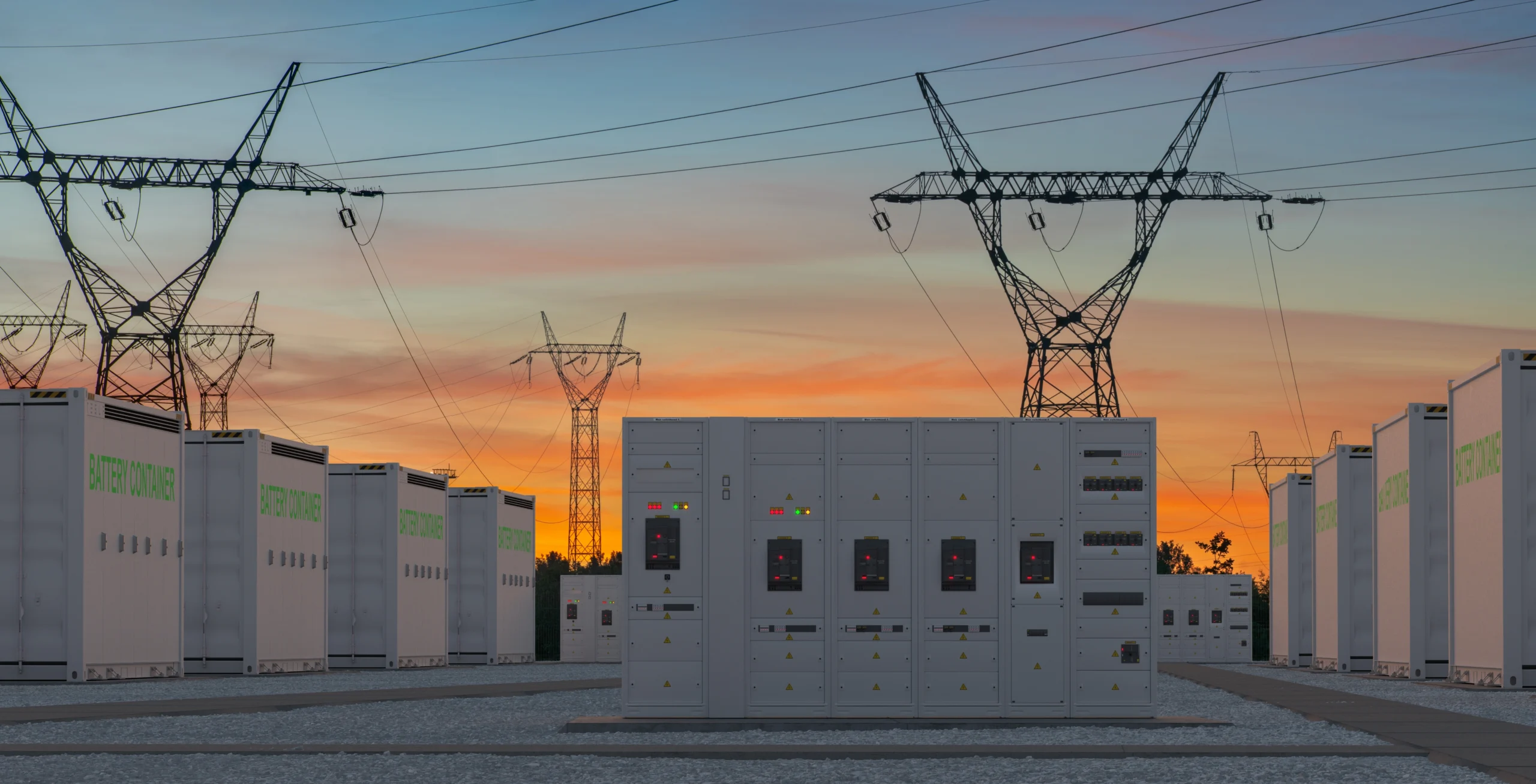
For long-standing veterans of the battery industry, it may seem miraculous or mysterious that so much demand growth is now being driven by stationary applications to support the electricity grid.
After all, the grid has been around for over 120 years, during which batteries have had virtually no role in keeping the lights on.
Of course, a key factor has been the advancement of lithium-ion technology.
Without the dramatic cost reductions that have occurred in the past two decades, it’s quite possible that there would still be little demand from the electricity industry for batteries.
However, the electricity sector is in the midst of dramatic changes, and those changes are creating a rapidly growing set of opportunities for batteries.
Among the numerous changes that are unfolding, one of the most important – and not just for the battery industry – is the increasing penetration of solar energy for electricity generation.
Solar energy used to be expensive, but now it’s cheap and increasingly ubiquitous
In 1954, Bell Labs developed the first practical photovoltaic (PV) cell to convert sunlight directly into electricity.
As is often the case with new technologies, early PV cells were both inefficient and expensive, which made them economically uncompetitive for application on the electricity grid, thereby relegating them to duty in niche applications such as spacecraft, where the grid was not a viable source of electricity supply.
A technology with many similarities to semiconductors, PV has benefitted from its own version of Moore’s Law, yielding steady improvements year-by-year in both conversion efficiency and manufacturing costs. As a result, the per-watt price of PV panels has fallen by about 99.8% in the past 50 years.
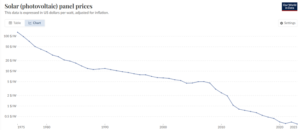
Image Source: Our World in Data
In turn, since the “fuel” that PV technology exploits to generate electricity – sunlight – is free, the cost of electricity produced by PV has also fallen dramatically.
One of the leading observers of power generation economics, Lazard estimates that the levelized cost of PV-based electricity has declined from $0.36/kWh in 2009 to $0.06/kWh in 2025, a level below the estimated cost of all other alternatives – coal, natural gas, nuclear, hydro, wind, and geothermal.
For this reason alone, PV now enjoys the majority market share of new capacity additions to electricity grids around the world.
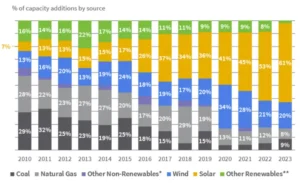
Image Source: CleanEdge
Consequently, PV is becoming almost ubiquitous, as it can be deployed virtually anywhere, at scales ranging from a household rooftop to solar farms stretching for acres.
Intermittency of output: solar energy’s Achilles heel
Notwithstanding its attractive cost structure and its other advantages, PV technology cannot escape the fact that the sunlight it requires to produce electricity is not always abundantly available.
Of course, it is obviously the case that PV doesn’t generate any electricity at all during nighttime hours.
But, as with any power plant, PV is not a binary fully-on or fully-off electricity-generating device, but rather produces power in proportion to the amount of fuel it is supplied: to produce electricity at its rated capacity, PV needs clear blue sky and the sun being perpendicular to the solar panel.
This means that PV produces less electricity when the sun goes behind clouds or (unless the panels are physically manipulated with “trackers” to follow the sun) is low on the horizon as it rises and sets.
The resulting variability in electricity output from installed PV systems – what electricity industry professionals term “intermittency” – creates a litany of operational and economic opportunities for battery energy storage systems.
Note that the electricity grid remains largely based on an architecture and on equipment from the early 20th Century: analog, centralized command-and-control, deterministic.
Today, grid operators still “dispatch” power plants by adjusting fuel burn (or water flow in the case of hydro) to match instantaneous electricity demands as it rises and falls.
As the electricity grid becomes more reliant on generation from PV systems, the degrees of freedom historically enjoyed by grid operators are declining.
A dwindling share of electricity supply from sources whose output can be adjusted by throttling fuel is being replaced by a growing share of electricity supply from sources that produce electricity only when and to the degree that the sun shines.
Obviously, one application of battery energy storage systems on the grid is to enable time-shifting of electricity from daytime to nighttime, charging mid-day when the sun is high in the sky, and discharging at night (especially during evening hours) to contribute to serving systemwide demands when PV otherwise is unable to produce electricity.
But it’s not just the inability of PV to supply electricity during evening hours that creates challenges for grid operators. Consider what happens as more and more PV is added to an electricity grid.
Grid operational challenges from intermittency and the “duck curve.”
For instance, consider California, an electricity grid with a peak demand of approximately 50,000 megawatts (MW).
As recently as 2010, there was only a little more than 100 MW of PV installed in California. By contrast, as of 2024, California is home to over 22,000 MW of installed PV, such that PV now supplies nearly one-quarter of California’s annual electricity demand.
With exponential growth in the installed base of PV in California, there are now many mid-day hours on the California electricity grid when there is “too much” supply, with output from PV systems around the state reaching maximum levels and exceeding aggregate electricity demand.
In these hours, either (1) electricity prices become negative to create a market signal for increased electricity consumption or (2) owners of generation assets will be paid NOT to supply electricity. Either way, this is an economic problem begging for a solution – a solution that can be provided by batteries.
A different problem arises later in the afternoon as the sun begins to set: not only does supply from PV decline quickly, electricity demand begins to rise as people return home from work and begin preparing dinner.
This double-whammy of effects means that the “ramp rate” – the rate of change in the volume of electricity to be supplied by the grid operator, as measured in MW/minute – is sometimes beyond what non-PV power-generating facilities can support.
When the profile of California electricity demand and supply is depicted over the course of such a day, and presented in comparison to similar days in previous years, a phenomenon known as the “duck curve” becomes apparent.
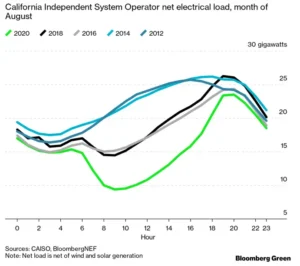
Image Source: Bloomberg Green, CAISO, BloombergNEF
A decade or more ago, before PV deployments were significant, systemwide electricity demand to be managed by the grid operator gradually increased all day long.
Now, with lots of installed PV systems, net electricity demand to be served by the grid declines in mid-day when PV output approaches rated capacity, followed by a steep rise in the late afternoon due to falling PV output as the sun sets.
The belly of the resulting duck shape in mid-day hours stems from an excess of PV supply, and the steepness of the rise in demand from the belly to the head of the duck in the late afternoon reflects the high degree at which other powerplants must be throttled up just to keep pace with accelerating demand.
The duck curve facing grid operators managing regional electricity systems increasingly supplied by PV is tailor-made to be solved by battery energy storage.
Batteries can absorb surplus mid-day electricity generation from PV, and discharge during the late afternoon into the evening both to reduce the steepness of the duck’s neck that causes operational difficulties and to serve peak demands in hours too late for PV to supply effectively.
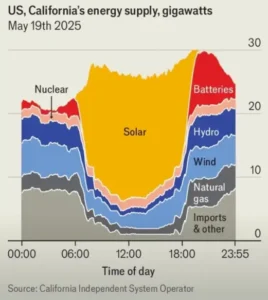
Image Source: California Independent System Operator
This duck curve phenomenon is by no means limited to California: it is appearing in grids all over the world where PV penetration has been significant, such as Australia, Germany and Spain.
In the U.S., the duck curve is a major factor in the emergence of Texas as the fastest growing market for battery energy storage with almost 4,000 MW installed in 2024 alone. Texas is the #1 growth market for batteries in the U.S. because – you guessed it – Texas is the #1 growth market for PV in the U.S., with abundant sunshine and vast expanses of low-cost non-arable real estate.
Solar and batteries increasingly coupled – both at project and industry level
In fact, the growth of PV and the growth of battery energy storage systems are increasingly linked. A growing proportion of PV projects are being installed with energy storage, and vice versa.
Virtually none of the major project developers active in the marketplace are specialists in one or the other, but rather have teams with expertise in both PV and battery storage technologies.
Thus, it is clear that the growth of the PV industry is a major force in the current growth of the battery industry. The two sectors should be – and in fact are becoming – fast friends.
In the energy sector, nothing is ever certain and nothing ever stays the same. It is true that the recent actions of the Trump Administration have not been helpful to U.S. prospects for PV.
While this may reduce the rate of U.S. PV market growth, it is unlikely to eliminate growth for several unalterable reasons.
First, except where fuels are extremely cheap or where sunshine is poor, PV still retains economic advantage over other sources of electricity generation.
Second, the supply chain for non-PV capacity alternatives (e.g., gas-fired turbines) is backlogged for many years, so many grids seeking new generation supplies will likely end up resorting to PV.
Third, several states (including large ones like California and New York) will likely continue with efforts to decarbonize their electricity grids, and additions of PV will play a prominent role.
As a result, the battery industry should not over-react to recent developments contrary to the interest of the PV sector, and instead should anticipate continued robust growth for deployment on U.S. electricity grids.
In serving U.S. electricity opportunities, the bigger challenge facing the battery sector is how to reduce dependence upon foreign (mainly Chinese) supplies and work to fortify a domestic supply chain that minimizes the disruptive effects of tariffs and other policies impeding international trade.
About the Author
With nearly 40 years of experience in electricity economics and energy-related innovation, Richard Stuebi helps clients develop and implement strategies for new energy technologies and build innovative business models with a focus on distributed energy resources such as energy storage and electric vehicles. He’s supported projects for numerous clients over the years and is available to support your organization for projects, big and small.