
Standardizing Batteries TRL-MRL Readiness
Aligning Industry Around TRL-MRL Readiness
- Client: LiBridge
- Industry: Battery Research & Development
Solution
Avicenne Energy partnered with Li-Bridge, a public-private alliance focused on accelerating a robust domestic lithium-based battery supply chain, along with leading battery industry stakeholders, to develop a standardized Readiness Assessment Framework for battery pre-production volumes. The framework aligned TRL and MRL definitions, clarified how “pilot production” should be interpreted, and established a more practical industry standard for the critical TRL 4-6 / MRL 3-5 journey.
Challenge
Battery manufacturers, OEMs, and ecosystem partners often use Technology Readiness Levels (TRL) and Manufacturing Readiness Levels (MRL) inconsistently. In many cases, the terms are casually mixed, and definitions vary from company to company. This creates confusion around how mature a battery program truly is, especially when organizations are benchmarking against competitors, working across partnerships, or deciding when a program is ready to move from R&D into pre-production
Results
The framework provides the battery industry a more consistent standard for assessing program maturity, reducing confusion between technical readiness and manufacturing readiness, and improving how companies benchmark, collaborate, and make scale-up decisions. By creating a more common language around pre-production readiness and pilot line capability, it helps organizations avoid misinterpretation, identify gaps earlier, and bring greater discipline to commercialization planning. We have already seen companies like Stellantis gain greater process discipline and rigor, a clearer understanding of where battery programs truly stood, and better visibility into gaps between technical maturity and manufacturing maturity.
Client & Market Context
Company Overview
Li-Bridge is a public-private alliance committed to accelerating the development of a robust and secure domestic supply chain for lithium-based batteries.
As battery and materials programs move from research to commercialization, OEMs, battery companies, and materials suppliers need consistent ways to assess whether those technologies can be manufactured at the scale, quality, and repeatability required for end applications such as electric vehicles, energy storage systems, and other commercial battery markets.
Battery Segment
This case primarily sits within the battery market’s path from R&D and prototype development to pre-production manufacturing and eventual commercial scale-up, with relevance across major end markets such as EV and ESS as well as military and specialty batteries.
Market Trends
The battery sector is under pressure to move faster, scale smarter, and reduce execution risk. Several trends make readiness discipline more important than ever:
- Global EV demand continues to push automakers to industrialize new battery technologies faster.
- Public and private investment in domestic battery supply chains is increasing.
- Federal agencies have begun adopting MRL nomenclature, making manufacturing readiness language more important in grant programs, partnerships, and public-private initiatives.
- Battery startups, OEMs, and suppliers often use different definitions for readiness, making cross-industry benchmarking difficult.
- The term pilot production has become increasingly ambiguous, often referring to very different scales, capabilities, and objectives depending on the company or technology stage.
In this environment, a common framework is necessary to improve communication, comparability, and decision-making.
Problem Definition
Core Issue
The core issue was the lack of a shared and disciplined way to evaluate whether a battery program was ready to advance.
Across the industry, TRL and MRL are frequently confused or blended together, even though they measure different things. This creates major issues when companies are:
- comparing internal programs,
- evaluating suppliers or partners,
- benchmarking against competitors,
- making scale-up decisions,
- or communicating with federal stakeholders and investors.
These misaligned definitions and understandings create friction and uncertainty, especially in the transition from prototype work to pre-production manufacturing.
What TRL and MRL Mean
Technology Readiness Level (TRL)
Technology Readiness Level (TRL) measures the maturity of the technology itself. It tracks how far a technology has progressed from concept through validation and toward commercialization. TRL usually spans 0 to 9.
TRL asks: Does the technology work?
Manufacturing Readiness Level (MRL)
Manufacturing Readiness Level (MRL) measures the maturity of the manufacturing process used to produce that technology. It focuses on whether the product can be made consistently, repeatably, and at the required scale and quality. MRL usually spans 1 to 10.
MRL asks: Can the technology be manufactured reliably at the required volume?
A battery program can have a relatively advanced TRL while still having a weak MRL. In other words, the chemistry or cell design may perform well technically, but the manufacturing process may not yet be standardized, automated, or ready for scaled production.
Why This Was a Problem for the Battery Industry
Inconsistent TRL and MRL definitions created three practical problems:
- programs could appear more mature than they actually were,
- manufacturing gaps were not always visible early enough,
- and teams lacked a common language for readiness reviews.
Key KPIs Impacted
The issue affected several strategic and operation
- program readiness accuracy,
- quality of stage-gate decisions,
- time to industrialization,
- scale-up risk,
- cross-functional alignment,
- and capital allocation efficiency.
Diagnostic Analysis (Framework-Driven)
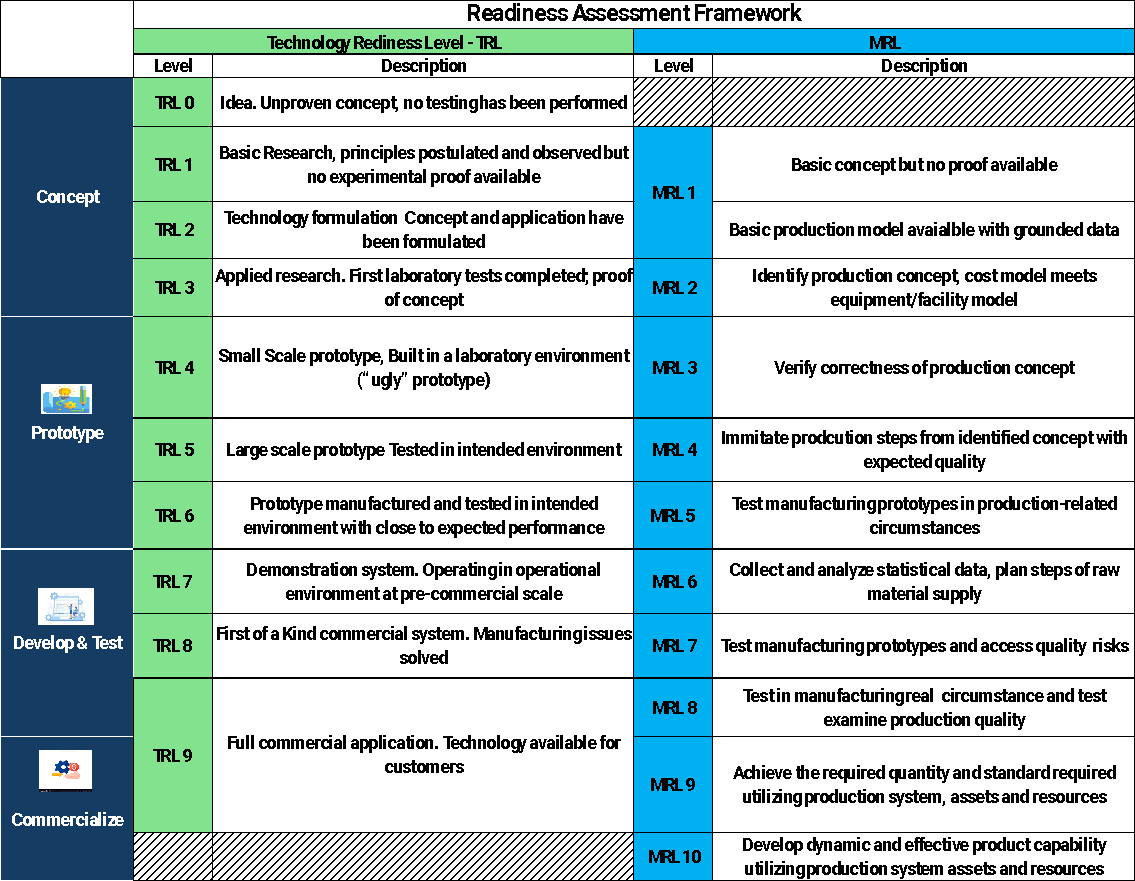
This is where the readiness framework became especially valuable. The framework was designed to establish industry standards for pre-production volumes, updating earlier volume assumptions with Avicenne’s real-world industry data. Through this work, it quickly became clear that the term pilot production means very different things to different organizations.That distinction matters because R&D pilot lines differ markedly from pre-production pilot lines.
The effort focused specifically on the MRL 3-5 / TRL 4-6 journey, the stage where battery companies move from early technical validation to manufacturable, repeatable, and increasingly automated production. The chart, established with Li-Bridge and industry input, helped create a common understanding in three important ways:
Implementation note
Readiness levels represent the progression of manufacturing maturity, but the activities required to achieve them may not occur sequentially. Planning and execution for prototype, pilot, and high-volume manufacturing lines may overlap, particularly when separate equipment, processes, and facilities are required at each stage.
TRL 1–3
Strong R&D Pilot Line Presence
R&D pilot lines covering TRLs 1-3 can be readily found throughout the U.S. These facilities support early material and cell development, but they could still be improved through stronger SOPs, better coordination, and more standardization.
TRL 4–6
Major Pre-Production Gap
The most important structural gap in the U.S. market is TRL 4-6. This is the stage where companies are trying to produce thousands of cells using standard automated manufacturing techniques. This capability is critical for bridging the gap between prototype success and scalable production, yet there is a major shortage of capacity and infrastructure at this stage.
TRL 7–9
Limited but Growing Capability
In the U.S., there’s a limited presence at higher pre-production volumes, though private-sector players are increasingly stepping in to fill this gap in response to organic customer demand.
For automotive OEMs and battery and materials manufacturers, this framework provided a better operational map of what readiness actually looks like at each stage and where the biggest gaps existed between technical progress and manufacturing capability.
For TRL 6 and beyond, OEMs and large companies may have internal processes that manage those stages, such as Stagegate, PSDP (Propulsion Systems Development Process), and/or MPRQ (Manufacturing Process Readiness Qualification). Higher stage TRLs would still apply, but internal systems may manage the actual progression to higher TRLs.
Timelines in the MRL and TRL framework were suggestions based on new chemistry and existing facilities. Timing and complexity when building new facilities could extend those significantly and require extensive project planning and execution.
Strategic Options
01
Continue Using Internal Definitions
Companies could have continued to use their own company- or team-specific definitions of TRL, MRL, and pilot production readiness.
ADVANTAGES:
Familiar and easy to maintain.
LIMITATIONS:
Continued inconsistency, weak benchmarking, poor comparability across programs, and a higher risk of misjudging readiness.
02
Adopt a Standardized TRL-MRL Readiness Framework
Companies could adopt the framework developed by Avicenne Energy, Li-Bridge, and industry stakeholders to create a common language for readiness reviews.
ADVANTAGES:
Better process discipline, stronger rigor, improved cross-functional alignment, clearer benchmarking, and earlier visibility into readiness gaps.
LIMITATIONS:
Requires adoption across teams and more structured program review processes.
Recommendation
CHOSEN STRATEGY:
The recommended strategy was for the battery industry to adopt the standardized TRL-MRL Readiness Assessment Framework as a core tool for evaluating battery programs and guiding scale-up decisions.RATIONALE:
This framework addresses a fundamental industry challenge: readiness ambiguity across technology development and manufacturing scale-up. By clearly separating technical maturity from manufacturing maturity, it gives battery companies, materials suppliers, OEMs, and other stakeholders a more realistic view of where a program actually stands. It also creates a more consistent industry language that can improve benchmarking, strengthen collaboration across the value chain, and align more effectively with increasingly important public-sector and federal terminology around manufacturing readiness.01
PHASE 1
Framework Alignment
Align internal teams around common definitions of TRL, MRL, and pilot production stages.
02
PHASE 2
Program Mapping
Assess active battery programs against both TRL and MRL, rather than relying on technical progress alone.
03
PHASE 3
Gap Identification
Identify where programs had meaningful disconnects between technical maturity and manufacturing maturity.
04
PHASE 4
Stage-Gate Integration
Use the framework to improve governance, investment timing, and readiness reviews.
05
PHASE 5
Continuous Refinement
Apply lessons learned across future programs, supplier interactions, and commercialization planning.
Results & Impact
Stellantis is one of several companies that have found value in utilizing the framework, which has helped in several important ways:
01
Introduced greater process discipline and rigor into battery program reviews.
02
Improved understanding of where battery programs truly are.
03
Revealed where they had gaps between technical maturity and manufacturing maturity.
This improved internal alignment, helped avoid overstating readiness, and supported more informed scale-up decisions.
Key Takeaways
Lessons Learned
01
Inconsistent definitions create real business risk. When companies use different definitions of readiness, collaboration, benchmarking, and scale-up planning become harder.
02
A common framework improves execution. Standardized readiness definitions help companies make better decisions, align teams, and reduce misinterpretation across the battery ecosystem.
Transferable Insights for Battery Market Players
This case is relevant not only for automotive OEMs, but also for:
- battery cell manufacturers
- battery materials manufacturers
- battery component and pack manufacturers,
- energy storage system manufacturers
- pilot line operators,
- equipment suppliers,
- investors
- and any organization evaluating the commercialization risk of batteries.
Any company trying to move from promising technology to scalable production can benefit from a framework that clearly distinguishes technical readiness from manufacturing readiness.
Built on Decades of Battery Market Expertise
Avicenne Energy U.S. helps battery and energy storage leaders make smarter decisions, faster, through combining industry-leading market intelligence with real-world expertise.
Our advisory network is built from experienced industry experts across materials, cell and Li-ion manufacturing, quality and process engineering, pack and system design, and electricity economics/site strategy.
The result: clear, decision-ready insight that reduces risk and accelerates execution.