Leverage expert insights and data to uncover the future direction of the data center energy storage market and strategically position your organization to seize upcoming opportunities.
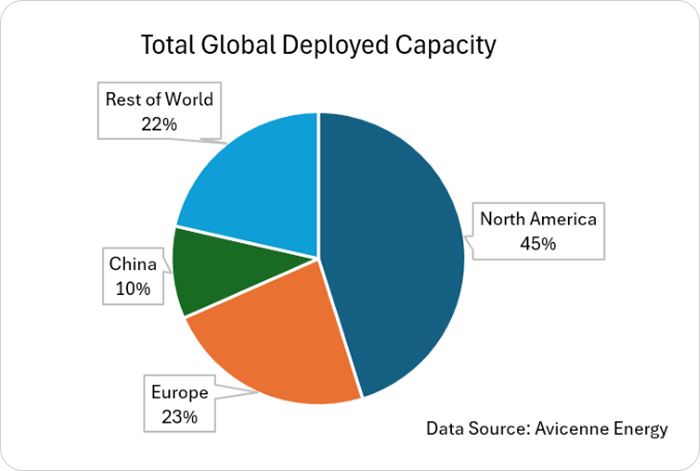
The United States has established itself as the dominant hub for global data center investment, hosting over 4,100 facilities—approximately 38% of the world’s total, according to Statista
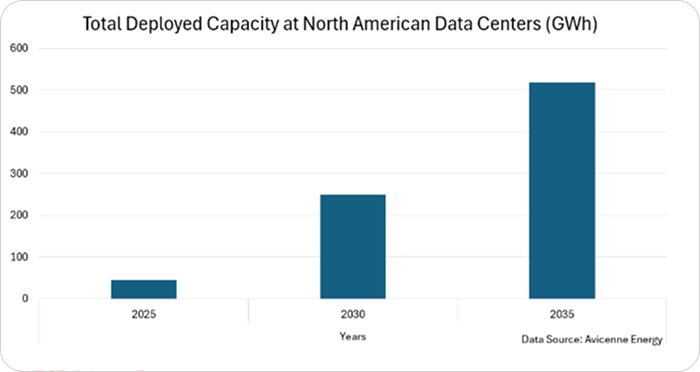
Deployed battery capacity across North American data centers is projected to grow from an estimated 45 GWh in 2025 to over 500 GWh by 2035
Data centers are specialized facilities designed to house the computing infrastructure that underpins the modern digital economy. These facilities contain servers, networking equipment, storage systems, and the power and cooling systems necessary to maintain their operation.
The demand for data center capacity has surged in recent years, fueled by a convergence of transformative trends. Cloud computing has shifted enterprise IT workloads from on-premises infrastructure to large, shared facilities operated by major providers such as Amazon, Google, and Microsoft. Additionally, the proliferation of streaming services, e-commerce platforms, and connected devices has created sustained baseline demand for data center resources.
The most significant driver of growth, however, is the rise of generative AI. Training and deploying large AI models require exponentially greater processing power compared to conventional applications, spurring a wave of investment in purpose-built AI data centers.
This unprecedented expansion is being led by hyperscale operators committing hundreds of billions of dollars to new capacity. Projections indicate that global data center power demand could double—or exceed that—by the end of the decade, underscoring the scale of this transformation.
SOURCE: Avicenne Energy
The United States has established itself as the dominant hub for global data center investment, hosting over 4,100 facilities—approximately 38% of the world’s total, according to Statista. Several structural advantages contribute to this leadership position.
The U.S. is home to many of the world’s largest technology companies, which are also the leading operators of data centers.The country benefits from deep capital markets, a mature real estate and construction ecosystem, and historically reliable access to power. Additionally, regulatory frameworks in the U.S. have generally been more permissive compared to other regions, enabling the rapid siting and construction of large-scale facilities.
Data centers are specialized facilities designed to house the computing infrastructure that underpins the modern digital economy. These facilities contain servers, networking equipment, storage systems, and the power and cooling systems necessary to maintain their operation.
The U.S. leads global data center expansion because it is at the center of demand for cloud, AI, and internet infrastructure, with major technology companies continuing to build at an unprecedented scale.
North America, led by the United States, currently represents the largest near-term opportunity for battery suppliers, driven by the region’s data center volume leadership. Meanwhile, China is rapidly scaling its infrastructure, presenting a growing market for advanced battery solutions. Both regions face the challenge of managing power constraints, enhancing resilience, and supporting higher-density AI infrastructure.
However, the pathways to adoption will differ, shaped by variations in market structure, policy frameworks, and grid conditions.
The rise of AI is fundamentally transforming power infrastructure within data centers. AI workloads generate rapid and unpredictable load swings, placing significant strain on traditional grid connections. This has accelerated the adoption of hybrid power architectures that integrate gas, batteries, and renewables. Additionally, the increasing density of AI racks is driving a shift toward 800V systems to better manage current, heat, and power quality at scale.
As a result, batteries are no longer limited to short-duration backup roles but are now integral to broader power management strategies.
In-rack batteries are gaining prominence as backup power solutions move closer to the compute load. These systems protect high- value servers, GPUs, and networking equipment while addressing fast- response power needs within the data center white space. As AI rack densities increase, battery architectures are evolving from embedded rack-level backups to dedicated battery racks or adjacent cabinets. This shift creates opportunities for compact, high-power systems designed to meet stringent space, safety, thermal, and integration requirements. For suppliers, success will depend on delivering complete rack-level power solutions that excel in response speed, form factor, battery management system (BMS) integration, thermal management, serviceability, and compatibility with broader data center power systems.
Uninterruptible power supply (UPS) batteries remain central to data center power continuity, providing short-duration backup power, bridging gaps to generators, and protecting facilities from outages, voltage disturbances, and power quality issues. As data centers scale, UPS systems are evolving into more flexible power infrastructure. Advanced chemistries and modular designs are improving footprint efficiency, monitoring capabilities, lifecycle performance, and deployment flexibility across hyperscale, colocation, and enterprise environments. Suppliers must focus on integrated, certifiable UPS battery solutions that address safety, thermal management, BMS and energy power management system (EPMS) integration, maintenance, runtime requirements, and compliance with approvals from authorities having jurisdiction (AHJs), insurers, OEMs, and operators.
Grid storage batteries represent a significant emerging opportunity at the data center site level. These systems support peak shaving, load smoothing, capacity management, and backup-adjacent functions, addressing challenges such as constrained grid access and rising power demand. As AI campuses expand, site-level storage is increasingly integrated into hybrid power architectures that combine utility power, on-site gas generation, renewables, and microgrid systems. Suppliers must deliver scalable storage solutions that align with data center reliability, safety, and operational requirements. Success will hinge on system integration, controls, permitting readiness, thermal and fire safety, lifecycle economics, and the ability to support both energy management and resilience objectives.
Deployed battery capacity across North American data centers is projected to grow from an estimated 45 GWh in 2025 to over 500 GWh by 2035—a more than tenfold increase. This growth is driven by the convergence of several forces: the rapid expansion of AI and high- performance computing, escalating power densities, and utilities’ inability to keep pace with interconnection demand.
The role of batteries within data centers is expanding far beyond traditional UPS backup. In-rack battery systems are emerging to address millisecond-level power demands of dense GPU clusters, while front-of-meter grid storage is increasingly deployed to stabilize supply, reduce demand charges, and unlock capacity in constrained markets.
This evolution represents not merely a scaling of existing infrastructure but a reimagining of how power is stored, managed, and delivered across the data center ecosystem.
In summary, the data center battery market is undergoing a profound transformation, driven by the demands of AI, regional dynamics, and the need for resilient, scalable power solutions. Suppliers who can align their offerings with these emerging trends will be well-positioned to capitalize on this rapidly expanding market.
Lead acid batteries continue to dominate deployment in enterprise data centers, largely due to their proven reliability, established safety profile, and mature supply chain. However, their market share is expected to decline as lithium-ion and next-generation chemistries gain traction, particularly in new construction projects where higher performance and energy density are prioritized.
Nickel-based lithium-ion batteries, particularly high-nickel NMC (nickel- manganese-cobalt) chemistries, are increasingly favored in high-density, space-constrained environments. Their superior energy density makes them well-suited for applications where batteries are integrated closer to IT equipment, such as rack-level architectures. As large new data centers come online, nickel-based lithium-ion solutions are becoming a critical component of next-generation power systems.
Lithium iron phosphate (LFP) batteries are emerging as the dominant lithium-ion chemistry for large-scale, site- level energy storage. LFP’s alignment with grid and campus-scale applications makes it particularly valuable in scenarios where data centers face constrained grid access, operate off-grid, or adopt hybrid power strategies. Its stability, safety, and lifecycle performance position LFP as a key enabler for integrating generation and storage capacity directly at data center sites.
Sodium-ion batteries show significant potential for large-scale, high-power on-site storage, particularly in managing AI-driven load swings inbehind-the-meter and co-located applications. While the technologyholds promise, it remains in the early stages of commercial validation and is not yet widely adopted in data center environments.
Nickel-zinc batteries offer an attractive solution for short-duration uninterruptible power supply (UPS) applications, typically requiring 10 minutes or less of backup power. With high power density and a compact footprint, nickel-zinc is gaining attention in enterprise piloting, though it remains in the early stages of deployment.
Iron-air batteries are best suited for grid-level storage applications, offering potential for long-duration energy storage. However, the technology currently faces limitations in footprint, response profile, and commercial readiness, which restrict its near-term applicability in data centers.
Solid-state and silicon-anode batteries represent promising advancements in energy density and safety. However, neither technology is currently available at the scale or in the formats required for data center qualification. These technologies remain in the early stages of development and are not yet ready for widespread deployment in mission-critical environments.
The data center battery market is no longer defined by a single technology pathway. Lead acid remains deeply embedded in existing enterprise environments, while lithium-ion is capturing more new-build opportunities as operators prioritize density, integration, and site-level energy flexibility. At the same time, emerging chemistries such as sodium-ion, nickel-zinc, iron-air, solid-state, and silicon-anode technologies are creating new possibilities, but each must be evaluated against the realities of qualification, safety, footprint, response time, supply availability, and commercial readiness.
For data center operators, battery suppliers, integrators, and investors, it’s critical to understand where each chemistry truly fits, when it can scale, and what tradeoffs will shape adoption. Avicenne Energy helps clients navigate these decisions with market intelligence, technology expertise, and practical insight across the evolving battery landscape.
Surging AI workloads, tightening grid constraints, and relentless uptime demands are rewriting the rules for data center infrastructure.
Our credible experts bring deep expertise across the data center value chain, from grid interconnection and backup power architecture to battery energy storage systems, in-rack and UPS batteries, and electricity economics, including value creation in generation and energy storage.
Whether you need a trusted partner to validate your technology, your infrastructure roadmap, or your strategic direction, our team has the hands-on experience to give you confidence in your decisions.
Reach out to explore how we can support your next milestone.