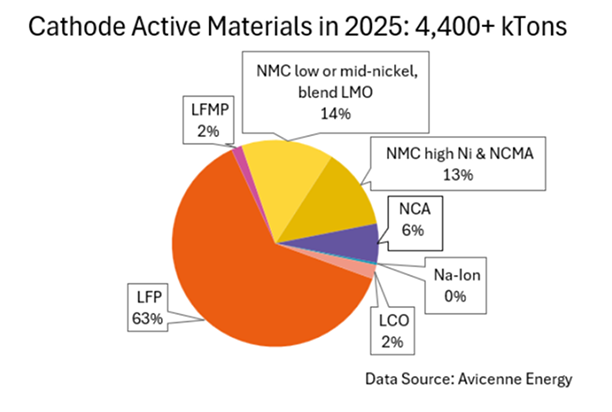
LFP: 63% of Global Li-ion Demand in 2025
LFP demand (including LMFP) will double by 2030
LFMP: 5% of Global Li-ion Demand by 2030
Lithium-iron phosphate (LFP) is a lithium-ion battery chemistry gaining significant adoption across electric vehicles, stationary energy storage, commercial and industrial systems, residential storage, fleet vehicles, buses, forklifts, telecom backup, and charging infrastructure. Its growth is driven by a strong combination of safety, long cycle life, cost competitiveness, and reduced dependence on critical minerals such as nickel and cobalt.
In an LFP cell, iron and phosphate form a highly stable cathode structure that improves thermal resilience and helps reduce the risk of overheating. This structural stability also supports durable performance across many charge-discharge cycles, making LFP especially well suited to applications that require frequent cycling, large-scale deployment, or installation near buildings, infrastructure, and mission-critical equipment.
LFP’s core advantages are safety, affordability, durability, and scalability. These characteristics have made it one of the leading chemistries for grid-scale storage, renewable energy integration, commercial energy storage, residential battery systems, standard-range electric vehicles, fleet applications, and other markets where lifecycle value is more important than maximum energy density.
The principal limitation of LFP is its lower energy density compared with nickel-based lithium-ion chemistries such as nickel manganese cobalt (NMC) and nickel cobalt aluminum (NCA). As a result, LFP systems may require greater mass or volume to deliver the same amount of energy. This can constrain their suitability in premium electric vehicles, aerospace, defense mobility, and other applications where compact packaging and weight reduction are critical design priorities.
As battery demand expands across transportation, energy storage, and industrial markets, LFP has become a foundational chemistry for safe and cost-effective electrification. Its balanced profile of reliability, material availability, operating safety, and economic scalability makes it a strategically important technology for organizations evaluating battery deployment across multiple end markets.
Lithium manganese iron phosphate (LMFP) is emerging as a strategically important intermediate battery chemistry, offering a potential bridge between the performance advantages of nickel-based lithium-ion chemistries and the cost, safety, and durability strengths of lithium iron phosphate (LFP). It is designed to address key limitations of both NMC and conventional LFP technologies.
By incorporating manganese into the traditional LFP olivine cathode structure, LMFP achieves a higher operating voltage, which directly improves energy density. This allows the chemistry to deliver greater range potential than standard LFP while preserving many of the intrinsic advantages that make phosphate-based batteries attractive, including strong thermal stability, robust safety characteristics, and durable cycling performance.
This combination positions LMFP as a credible alternative in applications where NMC-like range capability is desirable but where cost, safety, and material availability remain critical considerations. Compared with NMC, LMFP can reduce reliance on cobalt and nickel while maintaining a more favorable cost structure and supporting longer cycle life. Compared with standard LFP, it offers improved energy density, helping narrow the performance gap that has historically separated lower-cost phosphate chemistries from higher-energy nickel-based systems.
LMFP also demonstrates improved low-temperature performance relative to conventional LFP, an important advantage for electric vehicles operating in colder climates. Since low temperatures can reduce battery power, charging performance, and usable range, enhanced cold-weather behavior can materially improve real-world EV performance and customer experience.
Leading battery manufacturers and automotive OEMs are actively developing LMFP cells, viewing the chemistry as a strong candidate for mid-range electric vehicles where cost efficiency, safety, and practical energy density must be balanced. In this role, LMFP has the potential to bridge the market space between premium NMC-based platforms and more affordable LFP-powered vehicles.
LFP accounts for a 63% share of lithium-ion demand because it has become the preferred chemistry for applications where cost, safety, long cycle life, and scalable supply matter more than maximum energy density. Its use of iron and phosphate, rather than nickel and cobalt, gives it a stronger cost and supply-chain profile, making it especially attractive for stationary energy storage, mass-market EVs, buses, fleets, and industrial applications.
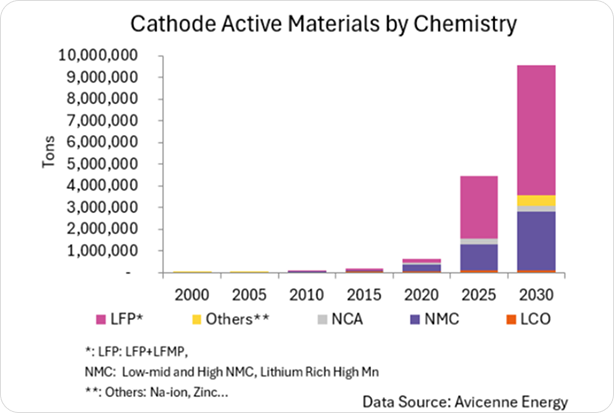
As battery demand expands beyond premium and long-range EVs into high-volume, cost-sensitive markets, LFP’s practical advantages have made it the workhorse lithium-ion chemistry across both transportation and energy storage.
Its combination of lower material cost, strong safety performance, long cycle life, and scalable supply makes it especially well-suited for mass-market EVs, buses, commercial fleets, residential storage, C&I systems, and grid-scale ESS.
In these applications, buyers often prioritize total cost of ownership, reliability, and supply availability over maximum energy density, which plays directly to LFP’s strengths. This has allowed LFP to capture demand across multiple fast-growing segments where batteries must be durable, affordable, and deployable at scale
Lithium manganese iron phosphate (LMFP) is expected to capture approximately 5% of global lithium-ion battery demand by 2030, reflecting its emergence as a pragmatic evolutionary pathway from conventional lithium iron phosphate (LFP). By incorporating manganese into the phosphate-based cathode structure, LMFP can achieve higher operating voltage and improved energy density while preserving many of LFP’s core advantages, including cost competitiveness, strong safety characteristics, and reduced dependence on nickel and cobalt.
This performance profile makes LMFP attractive for applications that require greater range or higher energy density than standard LFP can typically provide, but do not require the full performance envelope, material intensity, or cost structure associated with nickel-based lithium-ion chemistries such as NMC and NCA. In this sense, LMFP occupies a strategically important middle position between low-cost phosphate systems and higher-energy nickel-based platforms.
Adoption is likely to be strongest in mass-market electric vehicles, two-wheelers, commercial fleets, and select stationary storage applications where manufacturers are seeking a better balance of cost, safety, energy density, and supply-chain resilience. These markets can benefit from incremental performance gains over LFP without fully absorbing the cost and complexity of nickel-rich cathode chemistries.
However, LMFP’s projected share remains comparatively modest because the technology still requires broader validation before it can displace entrenched LFP or nickel-based platforms at scale. Key areas for continued qualification include cycle-life durability, low-temperature performance, manufacturing consistency, and large-scale commercial validation. As these factors mature, LMFP may become an increasingly important chemistry for applications positioned between standard-range LFP systems and premium nickel-based battery architectures.
LFP has become one of the leading chemistries for stationary energy storage systems because it offers a strong combination of safety, long cycle life, cost efficiency, and scalability. These attributes make it well suited for grid-scale and commercial storage applications that require frequent cycling and predictable long-term performance.
Its durability supports renewable energy integration, peak shaving, load shifting, and grid support, where lifetime economics often matter more than maximum energy density. LFP’s stable thermal behavior also strengthens its suitability for large installations where safety and system reliability are central design priorities.
LFP is gaining relevance in data center energy infrastructure, particularly for site-level and campus-level storage applications. It can support load management, backup power, renewable integration, and grid-interactive energy strategies where reliability, safety, and operational continuity are essential.
While some high-power uninterruptible power supply applications may favor chemistries optimized for rapid discharge, LFP is a strong candidate for bulk energy storage and broader facility-level resilience. Its lower maintenance requirements compared with legacy lead-acid systems also make it attractive for mission-critical environments seeking dependable, long-life energy assets.
Utility-scale solar and wind projects increasingly use LFP batteries to store intermittent renewable generation and shift energy delivery to periods of higher grid value. LFP’s long cycle life and lower material cost make it particularly effective for multi-hour storage systems where total cost of ownership is a decisive factor.
Because renewable energy storage assets may cycle frequently over many years, LFP’s durability and thermal stability provide important operational advantages. These characteristics support reliable performance in large-scale deployments while helping reduce safety and maintenance burdens.
For commercial buildings, factories, warehouses, and campuses, LFP supports demand-charge management, backup power, energy cost optimization, and resilience. Its combination of safety, cycle life, and cost-efficiency makes it a practical choice for organizations seeking to reduce energy expenses while improving power reliability.
LFP’s safer thermal profile is also advantageous in deployments near people, buildings, equipment, and critical infrastructure. This can simplify evaluation relative to chemistries with higher thermal-management demands, especially in distributed or behind-the-meter installations.
LFP is increasingly used in residential battery systems because homeowners and system providers value safety, long operating life, and low maintenance. It is well suited for solar self-consumption, backup power, time-of-use optimization, and resilience during grid outages.
In residential environments, thermal stability and reliability are especially important because batteries are often installed in or near occupied spaces. LFP’s strong safety profile and long cycle life make it a compelling chemistry for home energy storage systems designed for daily use over many years.
LFP is a strong fit for mass-market and standard-range electric vehicles where affordability, durability, and safety are prioritized over maximum driving range. Its lower-cost material base and reduced reliance on nickel and cobalt help automakers develop more cost-competitive EV platforms.
Although LFP generally has lower energy density than nickel-based chemistries, its economics and durability make it highly attractive for vehicles designed around practical daily driving needs. For many consumers and fleet operators, lifecycle value, reliability, and lower upfront cost can outweigh the need for premium range performance.
Electric buses, delivery vehicles, municipal fleets, and other commercial vehicles with predictable routes are well aligned with LFP’s strengths. These applications often involve frequent charging, repeated daily cycling, and long service-life expectations.
LFP’s cycle durability, safety profile, and operational consistency make it well suited for fleet environments where uptime and cost control are critical. Since many fleet vehicles return to depots for scheduled charging, LFP’s lower energy density is often less limiting than it would be in applications requiring maximum range from a compact battery pack.
Forklifts, automated guided vehicles, warehouse equipment, and other industrial motive applications are strong candidates for LFP batteries. These systems often require high uptime, frequent cycling, dependable power delivery, and reduced maintenance.
Compared with legacy lead-acid systems, LFP can improve operational consistency, reduce maintenance requirements, and support more efficient charging strategies. Its durability and safety characteristics make it particularly useful in warehouses, logistics facilities, and industrial environments where equipment availability directly affects productivity.
LFP batteries can be deployed alongside EV charging infrastructure to buffer demand, reduce grid-connection constraints, and manage peak loads. This is especially valuable at fleet depots, highway charging sites, and commercial properties where available grid capacity may limit charger deployment.
By storing energy and discharging during high-demand periods, LFP systems can help reduce infrastructure stress and improve charging-site economics. Its safety profile, long cycle life, and cost efficiency make it a practical chemistry for stationary support systems paired with high-utilization charging assets.
LFP can support telecom sites, network infrastructure, and critical backup power applications where reliability, safety, and long service life are essential. It can serve as a lower-maintenance alternative to lead-acid in both standby and cycling applications.
For telecom and critical infrastructure operators, LFP offers dependable performance, reduced maintenance burden, and strong thermal stability. These qualities are valuable in distributed sites that may be difficult to service frequently but require continuous power availability and resilient backup capability.
With over 30 years of battery market intelligence and hundreds of clients supported across the North American battery supply chain, Avicenne Energy brings deep technical and market expertise to the evolving role of LFP batteries across EV, stationary storage, industrial, and emerging energy applications. Our forecasts and strategic insights are grounded in real-world market behavior, helping clients understand where LFP is gaining traction, where its limitations matter, and how it compares against nickel-based lithium-ion, lead acid, and next-generation battery technologies.
Our team of seasoned experts brings hands-on experience across the lithium battery value chain, from materials understanding, materials selection, and cell design to next-generation battery development, cell testing, plant design, equipment selection, and quality system implementation. This combination of market intelligence and technical expertise allows us to support clients as they evaluate chemistry choices, manufacturing pathways, supplier strategies, and commercialization risks.
Whether you are assessing LFP adoption, validating a technology roadmap, refining your manufacturing strategy, or comparing battery chemistries across applications, Avicenne Energy can provide the expertise and clarity needed to make confident decisions. Contact us today to explore how we can help you move your next battery initiative forward.