
Semi-Solid-State Gen4a: 350 Wh/kg and 800 Wh/L expected
Solid-State Gen4b: 430 Wh/kg and 1100 Wh/L expected
Solid-State Gen4b: 430 Wh/kg and 1100 Wh/L expected
For large-format applications, including electric vehicles, the first generation of solid-state battery technology is more accurately characterized as a semi-solid or hybrid solid-state architecture. This generation, often referred to as Gen4a, represents an evolutionary extension of the current lithium-ion battery platform rather than a fundamental redesign of the electrochemical cell.
In Gen4a systems, the cathode and anode active materials remain broadly aligned with those used in conventional lithium-ion batteries. The primary innovation is concentrated in the electrolyte and separator architecture. Rather than relying on a traditional liquid electrolyte in combination with a separate polymer separator, these cells use a solid or solid-liquid hybrid electrolyte structure. Because the core electrode materials remain largely unchanged, Gen4a batteries are not expected to deliver a transformative improvement in energy density or overall energy performance. Their most important value proposition is improved safety.
By reducing the amount of flammable liquid electrolyte and enhancing separator stability, semi-solid and hybrid solid-state designs can help mitigate risks associated with electrolyte leakage, thermal runaway, and related safety failure modes. Gen4a should therefore be viewed as a strategically important transitional technology. It enables battery manufacturers and automakers to introduce solid-state concepts into large-format battery systems while continuing to leverage established lithium-ion materials, manufacturing expertise, and supply-chain infrastructure. This creates a more practical near-term pathway toward safer battery systems, even though the most substantial performance gains are expected to emerge from later generations of solid-state technology.
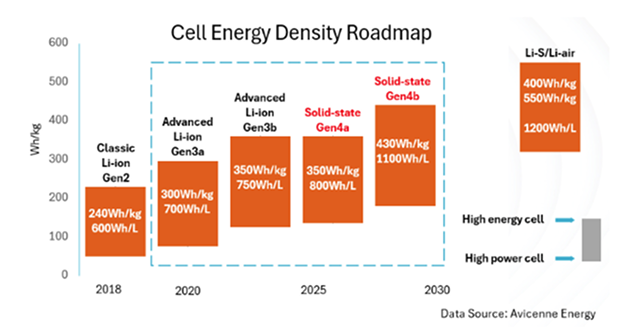

The second generation of solid-state battery technology, commonly referred to as Gen4b, represents a more advanced progression beyond semi-solid or hybrid solid-state designs. Gen4b is typically characterized as an all-solid-state battery architecture, in which the conventional liquid electrolyte and separate polymer separator are fully replaced by a solid electrolyte.
Like Gen4a, Gen4b remains rooted in the lithium-ion battery platform. However, it introduces a more consequential architectural shift. Beyond the replacement of the electrolyte and separator system, Gen4b also substitutes the conventional graphite-based anode with lithium metal. This change is strategically important because lithium metal has a substantially higher theoretical capacity than graphite, creating the potential for higher energy density and improved cell-level performance.
The expected value proposition of Gen4b combines safety improvement with enhanced energy performance. The solid electrolyte reduces dependence on flammable liquid components and can help mitigate safety risks associated with electrolyte leakage, internal shorting, and thermal runaway. At the same time, the use of a lithium metal anode can increase the amount of energy stored within the cell, supporting longer driving range, lighter battery packs, or more compact system designs.
As a result, Gen4b is viewed as a more transformative solid-state pathway than the first generation of semi-solid technologies. However, it also introduces more complex technical and manufacturing challenges. Lithium metal anodes require careful control to prevent dendrite formation, maintain stable cycling behavior, and ensure long-term durability. Solid electrolyte materials must also meet demanding requirements for ionic conductivity, mechanical stability, manufacturability, and interfacial compatibility with both electrodes.
For large-format applications such as electric vehicles, Gen4b represents a major target for next-generation battery development. If successfully commercialized, it could offer a stronger combination of safety, energy density, and performance than either conventional lithium-ion batteries or early semi-solid-state designs. Broad adoption, however, will depend on sustained progress in materials science, cell architecture, manufacturing scale-up, and real-world performance validation.
Semi-solid-state will account for the majority of that volume, especially in 2030 (160 of 171 GWh), but all-solid-state is expected to make significant progress by 2035 and exceed 200 GWh of annual production by that time.
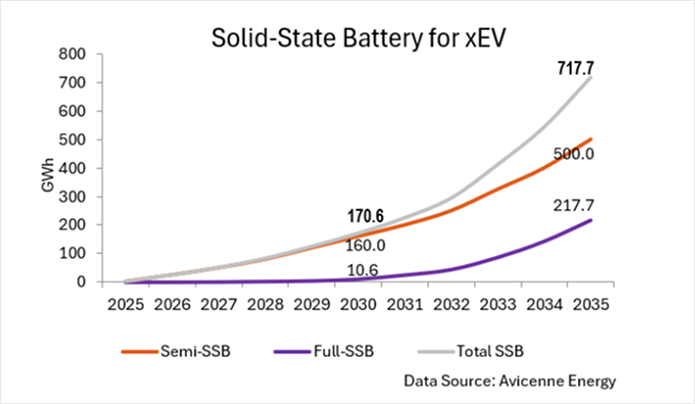
By 2030, full solid-state batteries are expected to remain a strategically important area of battery technology development. However, broad industrial-scale deployment is likely to remain constrained. Although all-solid-state architectures offer the potential for meaningful improvements in safety and energy density, they continue to face significant barriers related to materials performance, electrode-electrolyte interfaces, manufacturing scale-up, cost competitiveness, and long-term field validation.
As a result, full solid-state batteries are expected to reach only a relatively limited industrial production scale by 2030. Early commercialization will likely be concentrated in premium, specialized, or performance-driven applications where higher cost and restricted supply can be justified by improved energy density, enhanced safety, or more compact battery pack design.
Semi-solid-state batteries are expected to have a more visible near-term market impact. Some major Chinese battery manufacturers are likely to gradually shift portions of their production from conventional lithium-ion batteries toward semi-solid-state or hybrid solid-state architectures. This approach enables producers to introduce solid-state elements while continuing to leverage established lithium-ion materials, production equipment, manufacturing expertise, and supply-chain infrastructure.
The broader market impact is therefore expected to be meaningful, but still limited. By 2030, semi-solid-state adoption could influence roughly 5% of the relevant battery materials market, particularly in areas associated with electrolytes, separators, and cell architecture. This reflects a transitional phase in which conventional lithium-ion remains the dominant platform, semi-solid-state scales selectively, and full solid-state technology continues to mature for broader commercialization beyond 2030.
With more than 30 years of battery market intelligence and experience supporting hundreds of clients across the North American battery supply chain, Avicenne Energy U.S. brings a rigorous blend of technical expertise, market insight, and strategic perspective to the evolving solid-state battery landscape.
Our work spans semi-solid, hybrid solid-state, and full solid-state battery technologies. We help clients assess where these architectures are gaining commercial traction, where material and manufacturing risks remain, and how they compare with LFP, nickel-based lithium-ion, sodium-ion, and other next-generation battery platforms.
Avicenne Energy’s forecasts and strategic analyses are grounded in real-world market behavior, technology readiness, supply-chain dynamics, and application requirements. This enables clients to distinguish near-term commercial opportunities from longer-term development pathways and to evaluate solid-state batteries within the broader competitive context of advanced energy storage.
Our team brings hands-on expertise across the battery value chain, including materials understanding, materials selection, cell design, next-generation battery development, cell testing, plant design, equipment selection, and quality system implementation. This integrated capability allows us to connect chemistry-level performance with manufacturing feasibility, supplier readiness, application fit, and commercialization timing.
Whether you are assessing solid-state adoption, validating a technology roadmap, refining your manufacturing strategy, evaluating suppliers, comparing application opportunities, or planning commercialization, Avicenne Energy can provide the clarity and expertise needed to make confident decisions.
Contact Avicenne Energy to discuss how we can support your next solid-state battery strategy, technology, or market initiative.