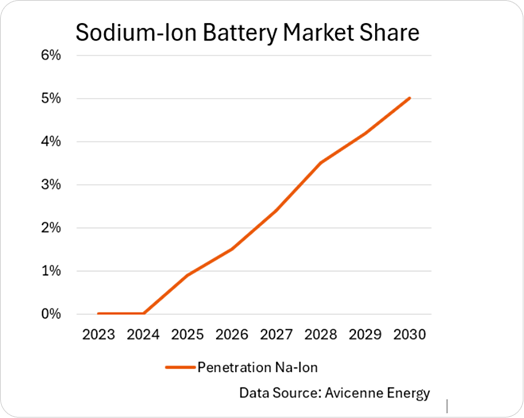
Forecasted for 5% Share of 2030 Global Battery Demand
181 GWh Annual Production Expected by 2030
North America to Account for 10% Share of 2030 Production
Sodium-ion batteries are an emerging class of rechargeable battery technologies in which sodium ions serve as the primary charge carrier, moving between the cathode and anode during electrochemical operation. During charging, sodium ions migrate from the cathode through the electrolyte into the anode. During discharge, those ions return to the cathode while electrons flow through the external circuit to deliver usable power.
The fundamental operating principle is analogous to lithium-ion batteries, but the underlying material system is distinct. Sodium is more abundant and more broadly distributed than lithium, giving sodium-ion batteries a potential advantage in supply-chain resilience, raw-material availability, and long-term cost stability. These attributes are becoming increasingly relevant as battery demand expands across electric vehicles, stationary energy storage, industrial systems, and data center power applications.
The primary limitation of sodium-ion technology is energy density. Because sodium ions are larger and heavier than lithium ions, sodium-ion batteries generally store less energy per unit of mass or volume than leading lithium-ion chemistries, particularly high-nickel NMC and NCA. As a result, sodium-ion is less compelling in applications where maximum driving range, payload capacity, or highly compact packaging is a critical design requirement.
Sodium-ion’s strongest value proposition is in use cases where safety, material availability, high power capability, low-temperature performance, cost stability, and supply-chain diversification are more important than maximum energy density. This may include stationary energy storage, short-range mobility, industrial equipment, data center power support, and other applications where reliable performance at an acceptable cost is the primary objective.
Sodium-ion should also be understood as a technology family rather than a single chemistry. Multiple cathode pathways are under development, including layered oxides, polyanionic materials, and Prussian blue or Prussian white analogs. Each pathway carries different implications for energy density, power capability, cycle life, thermal stability, cost structure, manufacturability, and supply-chain readiness.
Sodium-ion battery production is forecasted to reach 181 GWh by 2030. China is expected to lead global production, supported by the world’s most developed battery manufacturing ecosystem. Its strengths in cell manufacturing, battery materials processing, production equipment, pack integration, and energy storage deployment give domestic producers a significant structural advantage as sodium-ion advances from pilot-scale development toward broader commercialization.
China also has substantial domestic demand in the markets where sodium-ion is most likely to gain early traction. These include cost-sensitive electric vehicles, two-wheelers, low-speed vehicles, battery swapping, stationary storage, industrial energy systems, and data center power support. This large addressable market provides Chinese producers with a meaningful platform to validate performance, improve manufacturing yields, refine system integration, and reduce costs through scale.
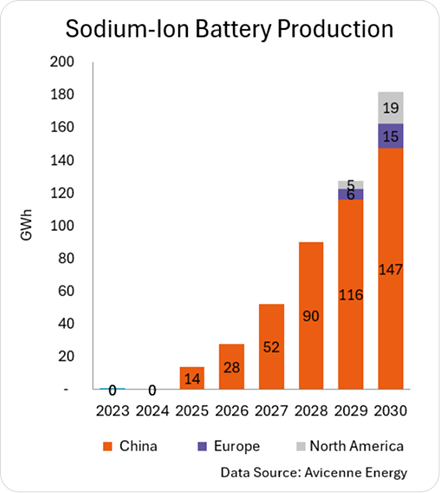
North America is projected to represent 10% of global sodium-ion battery production by 2030, supported by a combination of domestic battery manufacturing policy, rising interest in non-lithium chemistries, and expanding demand from stationary energy storage and data center power applications.
Sodium-ion is particularly well aligned with use cases where customers are seeking safer, lower-cost battery systems with reduced exposure to lithium, nickel, and cobalt supply chains. Its strategic relevance is also strengthened by growing efforts to reduce dependence on foreign-entity-of-concern-heavy supply networks, especially in applications where supply-chain resilience, cost stability, and domestic production capacity are becoming increasingly important procurement criteria.
Sodium-ion batteries are strategically attractive because they can reduce dependence on lithium, nickel, and cobalt—materials that have introduced significant cost volatility, sourcing complexity, and geopolitical exposure across the lithium-ion battery supply chain. By replacing lithium with sodium as the active ion, sodium-ion technology creates a pathway toward battery systems based on more abundant input materials and potentially more flexible regional supply chains.
Cathode selection varies significantly by sodium-ion design, and each pathway carries distinct performance and commercialization implications. Layered oxide cathodes can offer higher energy density, making them relevant for mobility applications and other use cases where stronger energy performance is required. Polyanionic cathodes can provide strong structural stability, safety, and high-power capability, which may make them suitable for rapid charge-discharge applications, peak shaving, and mission-critical power support.
Prussian blue and Prussian white analogs are also under development because they can use relatively abundant materials and may support lower-cost production, although long-term durability and manufacturing consistency remain important considerations.
The anode is another critical factor in sodium-ion commercialization. Many sodium-ion cells use hard carbon because sodium ions do not intercalate into conventional graphite as effectively as lithium ions. This creates an opportunity to develop new hard carbon supply chains, but it also introduces a meaningful scale-up challenge. The cost, quality, precursor selection, and consistency of hard carbon materials will play an important role in determining how quickly sodium-ion batteries can move from early commercialization to broader market adoption.
Sodium-ion can leverage parts of the existing lithium-ion manufacturing knowledge base, including cell assembly, electrolyte handling, separators, current collectors, formation, testing, and quality systems. However, it should not be viewed as a simple drop-in substitute for lithium-ion. Cathode production, anode supply, electrolyte salts, moisture control, cell design, qualification standards, and customer validation all require further maturation before sodium-ion can compete at lithium-ion scale.
Although sodium itself is abundant, the broader commercial ecosystem for sodium-ion cathode active materials, hard carbon anodes, electrolyte salts, and qualified cell production remains comparatively early. Long-term competitiveness will depend not only on electrochemical performance, but also on material scale-up, manufacturing yields, cell consistency, bankability, and the ability to qualify suppliers across multiple regions.
One of the most compelling near-term opportunities for sodium-ion batteries is high-power performance.
In several emerging designs, sodium-ion is not being positioned primarily as a direct substitute for LFP, but rather as a high-power solution for applications that require rapid charge and discharge capability. This distinction is strategically important: sodium-ion’s strongest commercial pathway may not depend on matching lithium-ion energy density, but on serving duty cycles where power delivery, operational safety, and cycling behavior are more important than maximum stored energy per unit of mass or volume.
Data centers provide a strong example of this opportunity.
The growth of AI workloads is creating more volatile and less predictable power demand profiles, increasing the need for battery systems that can support peak shaving, fast response, power smoothing, and UPS-adjacent functions. In these environments, batteries may need to respond quickly, cycle frequently, and manage short-duration power fluctuations rather than remain largely idle as traditional standby backup assets.
High-power sodium-ion systems could therefore compete with supercapacitors, lithium-ion, nickel-zinc, and lead-acid technologies in these applications. Supercapacitors can deliver exceptionally high power, but they are constrained when meaningful energy storage or backup duration is also required. Lithium-ion benefits from a mature commercial ecosystem, yet certain high-power and high-frequency cycling profiles can create challenges related to thermal management, lifetime degradation, and system sizing.
Sodium-ion may offer a differentiated alternative where customers require both strong power capability and sufficient energy storage to support more than momentary response.
The central challenge is validation. Data center duty cycles can be demanding, with limited idle time, frequent charge-discharge events, and increasingly dynamic load behavior driven by AI computing. Sodium-ion systems targeting these markets must demonstrate reliable performance at the cell, module, rack, and full-system levels. Critical qualification areas include thermal management, cycle life, safety, controls integration, and real-world behavior under AI-driven load profiles.
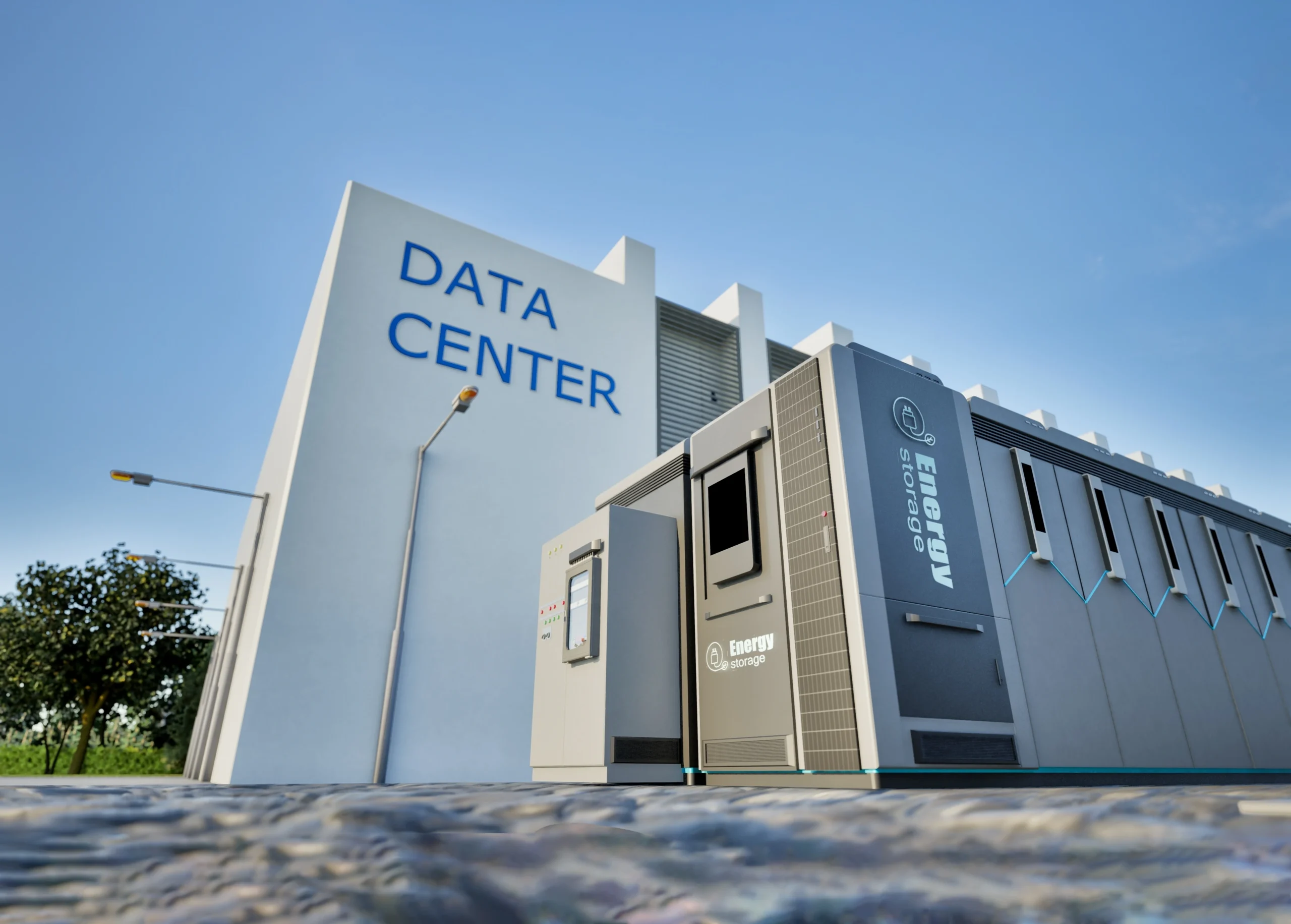
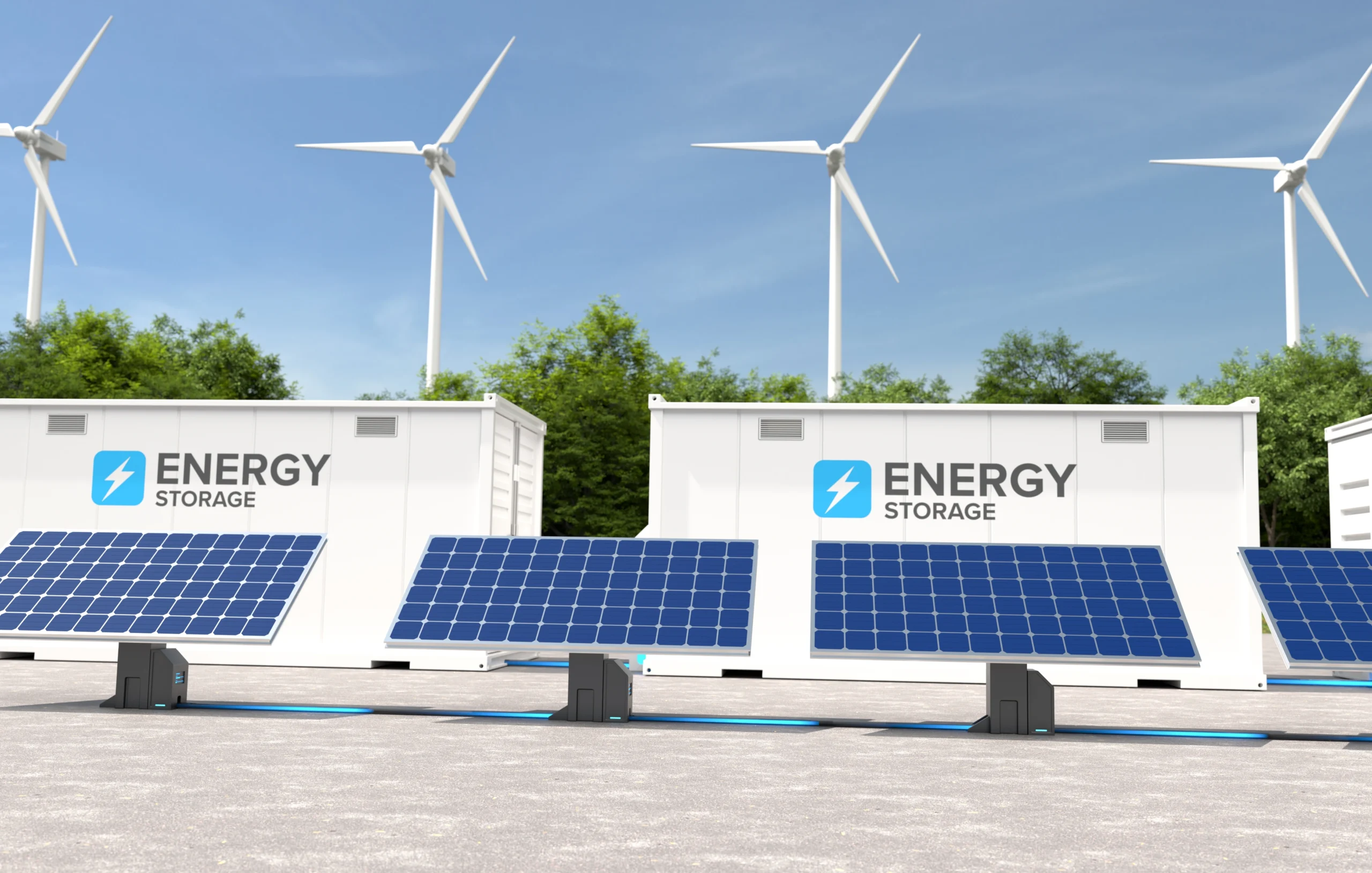
Sodium-based battery technologies also include higher-temperature systems engineered specifically for long-duration energy storage.
These systems are distinct from room-temperature sodium-ion cells, but they remain an important part of the broader sodium battery landscape because they use sodium-based electrochemistry to address stationary storage requirements.
These batteries are being positioned for applications where low cost, operational safety, long service life, and multi-hour discharge capability are more important than compact system design. Potential use cases include grid-scale storage, renewable energy firming, commercial and industrial load shifting, microgrids, behind-the-meter energy management, and large data center campuses that require more than short-duration backup power.
In long-duration storage markets, sodium-based systems may compete with LFP, flow batteries, iron-air batteries, compressed air energy storage, pumped hydro, and other emerging storage technologies. The central competitive question is not simply which technology offers the highest energy density. Rather, it is which solution can best meet site-specific requirements for discharge duration, safety, lifetime, round-trip efficiency, project cost, permitting, and system integration.Data centers may become an especially important test case.
As power availability becomes a constraint for large campuses, operators may need storage systems that can support demand charge management, grid constraint mitigation, on-site generation, renewable integration, and longer-duration backup. Sodium-based systems could play a role in this environment if they can meet stringent reliability expectations and integrate effectively with power electronics, controls, cooling systems, and site-level energy management platforms.
Sodium-ion batteries are gaining strategic relevance across applications where safety, cost stability, material availability, power capability, and supply-chain diversification are important selection criteria. Their value proposition is strongest in markets where maximum energy density is not the primary requirement, and where customers are seeking alternatives with reduced exposure to lithium, nickel, and cobalt supply chains.
Sodium-ion is a strong candidate for stationary energy storage systems because these applications often prioritize safety, long service life, cost efficiency, and scalable deployment over maximum energy density. Stationary systems may use sodium-ion batteries for renewable energy integration, peak shaving, load shifting, backup support, and grid services.
Because sodium is abundant and broadly available, sodium-ion could offer a more diversified material base than conventional lithium-ion systems. This may be attractive for utilities, project developers, and commercial customers seeking lower raw-material exposure and improved supply-chain resilience. Adoption will depend on demonstrated cycle life, system efficiency, bankability, and cost competitiveness against LFP and other established storage technologies.
Sodium-ion is receiving increasing attention for data center and mission-critical power applications, particularly as AI workloads create more dynamic and less predictable power demand profiles. High-power sodium-ion designs may support peak shaving, rapid charge and discharge, power smoothing, and UPS-adjacent functions.
In these environments, batteries may need to respond quickly and cycle frequently rather than remain idle for emergency backup. Sodium-ion could be relevant where operators need a combination of fast response, safety, acceptable energy storage duration, and reduced dependence on constrained lithium-ion material supply chains. However, systems targeting data centers must prove performance under demanding duty cycles, including thermal behavior, cycle life, controls integration, and reliability at the rack and system level.
Broader sodium-based battery systems may be relevant for long-duration storage applications requiring multi-hour discharge, potentially ranging from 4 hours to 24 hours or more. These systems can support grid storage, renewable firming, commercial and industrial energy management, microgrids, and large campuses that need to manage power availability over extended periods.
For these use cases, the central value drivers are low cost, safety, long service life, and the ability to deliver reliable capacity over long discharge windows. Sodium-based systems may compete with LFP, flow batteries, iron-air, compressed air, pumped hydro, and other emerging storage technologies. Their success will depend less on energy density and more on total project economics, round-trip efficiency, permitting, durability, and integration with site-level power infrastructure.
Commercial and industrial facilities may use sodium-ion batteries for demand charge reduction, backup power, resilience, and behind-the-meter energy optimization. Factories, warehouses, campuses, and commercial buildings often need storage systems that can reduce energy costs while improving reliability and operational continuity.
Sodium-ion is especially relevant where customers want safer and potentially lower-cost systems with less exposure to lithium, nickel, and cobalt supply chains. Its material profile may support more stable procurement economics, while its safety characteristics may improve suitability for installations near buildings, equipment, and personnel. Market adoption will depend on proven lifecycle performance, integration with existing electrical systems, and competitiveness against LFP and other established C&I storage options.
Sodium-ion may be attractive for short-range and cost-sensitive electric mobility applications, including low-cost EVs, two-wheelers, three-wheelers, compact cars, and light-duty vehicles. In these markets, affordability, safety, supply-chain resilience, and acceptable range may matter more than maximum driving range or premium performance.
The principal limitation is energy density. Sodium-ion generally stores less energy per unit of weight or volume than high-nickel lithium-ion chemistries, making it less suitable for premium long-range EVs where range, payload, and compact pack design are critical. Its near-term mobility opportunity is therefore more likely in practical, lower-cost vehicle segments where daily driving requirements are modest and total cost of ownership is a decisive factor.
Forklifts, automated guided vehicles, warehouse equipment, and other industrial motive applications could be a strong fit for sodium-ion if the chemistry demonstrates robust cycle life, safety, and cost performance. These applications often prioritize uptime, predictable operation, fast charging, and total cost of ownership over maximum energy density.
Sodium-ion’s potential high-power capability and material availability could make it useful in logistics, manufacturing, and warehouse environments where equipment cycles frequently and downtime is costly. To gain adoption, sodium-ion systems will need to prove reliability against incumbent lead-acid and lithium-ion solutions, particularly in demanding operational settings with frequent charge-discharge events.
Sodium-ion and broader sodium-based systems could compete in telecom backup, network infrastructure, and other critical standby power applications. These markets value safety, reliability, long service life, low maintenance, and dependable performance across distributed sites.
The opportunity is strongest where operators are seeking alternatives with improved supply-chain diversification and reduced dependence on lithium, nickel, and cobalt. However, sodium-ion will face significant competition from entrenched lead-acid, LFP, and nickel-zinc systems. To displace these technologies, sodium-ion must demonstrate compelling field reliability, service life, safety performance, and total cost of ownership.
Sodium-ion batteries may be deployed alongside EV charging infrastructure to buffer demand, reduce grid-connection constraints, and manage peak loads. This could be valuable at fleet depots, highway charging sites, commercial properties, and other locations where available grid capacity limits charger deployment.
By storing energy and discharging during periods of high demand, sodium-ion systems could improve charging-site economics and reduce stress on local electrical infrastructure. Their relevance will be strongest where cost, safety, cycle life, and supply-chain resilience matter more than compactness. Adoption will depend on proven performance in high-utilization environments, integration with charging systems, and competitiveness against LFP and other stationary storage technologies.
Sodium-ion is expected to remain a relatively small, but strategically important, segment of the battery market by 2030. Its projected share reflects both the technology’s significant potential and its current limitations. On the opportunity side, sodium-ion offers a pathway to reduce dependence on lithium, nickel, and cobalt at a time when battery demand is expanding across transportation, stationary storage, data centers, and industrial systems.
This material profile is increasingly attractive for customers seeking greater cost stability, supply-chain diversification, and reduced exposure to constrained or geopolitically sensitive inputs.
At the same time, sodium-ion must compete against highly mature lithium-ion platforms, particularly LFP. LFP already benefits from large-scale manufacturing capacity, well-developed supply chains, established bankability, extensive field validation, and continued cost-reduction momentum. These advantages create a high competitive threshold for sodium-ion, especially in markets where LFP already delivers a strong balance of safety, cost, cycle life, and system-level performance.
Sodium-ion adoption is likely to develop first in applications where its material advantages and performance profile are most relevant. These include stationary energy storage, cost-sensitive mobility, short-range vehicles, industrial systems, and emerging high-power applications. Broader adoption will depend on how quickly sodium-ion producers can improve energy density, validate cycle life, scale hard carbon anode and cathode material supply, reduce manufacturing cost, and qualify systems with customers already familiar with LFP, NMC, lead-acid, and other established battery chemistries.
Sodium-ion’s most direct lithium-ion competitor is LFP. Both chemistries are positioned around safety, cost efficiency, durability, and reduced reliance on nickel and cobalt. However, LFP currently holds the stronger commercial position. It has already scaled across electric vehicles, grid storage, commercial energy storage, residential systems, and industrial applications. It also benefits from mature manufacturing processes, broad supplier availability, a growing installed base, and strong confidence among customers, financiers, and system integrators.
Sodium-ion can still succeed in targeted applications if it delivers a clearly differentiated value proposition. Potential advantages include lower exposure to lithium supply risk, strong low-temperature performance, high-power capability in certain cell designs, and more flexible raw material sourcing. These attributes may be valuable in applications where supply-chain resilience, safety, power delivery, or cost predictability matter more than maximum energy density.
Even so, sodium-ion will need to compete against an LFP ecosystem that is not static. LFP continues to improve in cost, energy density, safety, manufacturing efficiency, and system integration. As a result, sodium-ion’s commercial success will depend not only on its intrinsic chemistry advantages, but also on its ability to demonstrate superior value in specific applications where LFP is less optimized.
Sodium-ion may also compete with nickel-based lithium-ion chemistries in applications where customers are willing to trade some energy density for lower cost, improved material availability, or a different safety profile. However, high-nickel chemistries such as NMC and NCA will remain difficult to displace in applications where compactness, weight reduction, and high energy density are essential. These include long-range electric vehicles, aerospace, defense mobility, drones, eVTOL platforms, and other performance-intensive use cases.
In backup power and mission-critical systems, sodium-ion may compete with lead-acid, VRLA, nickel-zinc, LFP, and supercapacitors. Lead-acid remains familiar, widely deployed, and relatively low cost, but it can be constrained by weight, footprint, maintenance requirements, shorter cycle life, and performance limitations under demanding duty cycles. VRLA systems offer established standby power capability, but face similar challenges in applications requiring frequent cycling or higher power density.
Nickel-zinc offers strong high-power performance and a favorable safety profile, particularly in UPS and backup power environments. LFP provides a mature, scalable alternative with strong cycle life and proven deployment across stationary and industrial applications. Supercapacitors can deliver extremely rapid power response and very high cycle life, but they are typically limited when meaningful energy storage duration is required.
Sodium-ion’s opportunity is to occupy the middle ground among these technologies. It may be most competitive where customers need a practical balance of power capability, safety, cost, material availability, and usable energy duration. Its role will depend on whether suppliers can translate chemistry-level promise into reliable, bankable, and cost-effective systems for specific commercial and industrial duty cycles.
Read more about other chemistries here:
With more than 30 years of battery market intelligence and a proven record supporting hundreds of clients across the North American battery supply chain, Avicenne Energy brings a rigorous combination of technical expertise, commercial insight, and strategic perspective to the evolving sodium-ion battery landscape.
Our work spans stationary energy storage, data center power infrastructure, industrial applications, mobility, and emerging energy markets where sodium-ion may offer differentiated value through material availability, supply-chain diversification, safety, cost stability, high-power capability, and application-specific performance.
Avicenne Energy’s forecasts and strategic insights are grounded in real-world market behavior. We help clients evaluate where sodium-ion batteries are gaining commercial traction, where their technical and economic limitations remain material, and how sodium-ion compares with LFP, nickel-based lithium-ion, lead-acid, nickel-zinc, flow batteries, and other next-generation energy storage technologies.
Our team also brings hands-on experience across the battery value chain, including materials understanding, materials selection, cell design, next-generation battery development, cell testing, plant design, equipment selection, and quality systems implementation. This integrated perspective allows us to connect chemistry-level performance with manufacturability, supply-chain readiness, application fit, and commercial viability.
Whether you are assessing sodium-ion adoption, validating a technology roadmap, refining a manufacturing strategy, evaluating supplier options, comparing battery chemistries across applications, or managing commercialization risk, Avicenne Energy can provide the expertise and clarity required to make confident, well-informed decisions.
Contact Avicenne Energy to discuss how we can support your next sodium-ion battery strategy, technology, or market initiative.