$49.7 Billion Market in 2025
17% Share of Rechargeable Battery Market
0.9% CAGR 2015-2025
Lead-acid batteries are among the most established rechargeable battery technologies in the global energy storage landscape. First commercialized more than a century ago, they remain widely deployed because they are proven, relatively low cost, highly recyclable, and supported by mature manufacturing, distribution, service, and recycling infrastructure across major markets.
The underlying electrochemistry is well understood. In a conventional lead-acid cell, the positive electrode is typically lead dioxide, the negative electrode is sponge lead, and the electrolyte is sulfuric acid. During discharge, electrochemical reactions between the lead-based electrodes and the sulfuric acid electrolyte generate electrical energy. During charging, the reaction is reversed, restoring the active materials so the cell can be reused.
Lead-acid batteries continue to be valued for their reliability, high surge current capability, low initial cost, and broad operational familiarity across industrial, automotive, telecom, backup power, and motive power applications. Their value proposition is strongest where weight and energy density are secondary to dependable power delivery, cost efficiency, established maintenance practices, and proven field performance.
However, the technology also has clear structural limitations. Lead-acid batteries are heavy, offer lower energy density than lithium-ion systems, and may deliver shorter cycle life in applications involving frequent deep discharge. Depending on the format and installation environment, certain lead-acid systems may also require ventilation, periodic maintenance, spill containment, or hydrogen monitoring.
These constraints are creating openings for lithium-ion, zinc-based, sodium-ion, and other alternative battery chemistries in markets where customers require higher performance, lower maintenance, smaller system footprint, improved cycling capability, or longer service life.
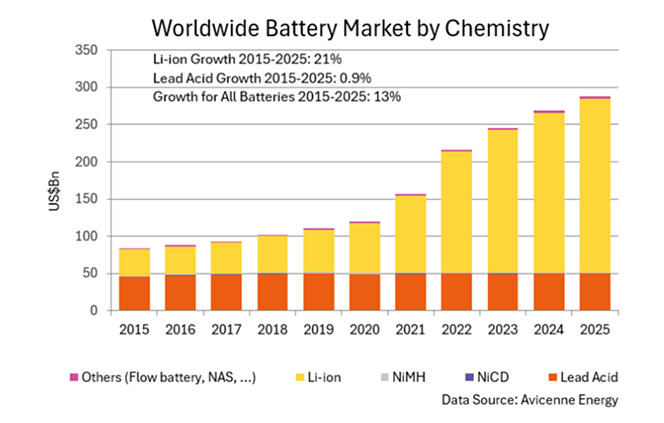
Lead-acid has retained a stable position within the battery market over the past decade, recording a 0.9% CAGR from 2015 to 2025. However, this growth trajectory remains modest when compared with lithium-ion, which delivered a substantially stronger 21% CAGR over the same period.
Lead-acid batteries encompass several distinct design architectures, each optimized for different performance requirements, installation environments, maintenance expectations, and cost constraints. While all rely on the same fundamental lead-acid electrochemistry, differences in electrolyte management, sealing, internal construction, and additive materials create meaningful variation in application fit and lifecycle performance.
Flooded lead-acid batteries are the traditional and most established lead-acid format. They use a free liquid sulfuric acid electrolyte, with the plates immersed directly in the electrolyte solution. This architecture is widely deployed in automotive starting, industrial equipment, backup power, and stationary energy storage applications.
Their principal advantages are low upfront cost, proven reliability, broad supplier availability, and long-standing familiarity among installers, operators, and service providers. However, flooded systems can require more active maintenance than sealed alternatives. Depending on the application and installation environment, they may require periodic watering, ventilation, spill containment, electrolyte monitoring, and hydrogen management.
As a result, they remain highly relevant where cost and proven performance are priorities, but less attractive in applications where maintenance reduction, compact installation, or indoor deployment flexibility is critical.
Valve-regulated lead-acid batteries, or VRLA batteries, are sealed lead-acid systems designed to reduce maintenance requirements and limit electrolyte handling. Instead of allowing routine electrolyte access, VRLA batteries use internal gas recombination and pressure-regulating valves to manage operation under normal conditions.
VRLA batteries are widely used in UPS systems, telecom backup, security systems, emergency lighting, and other standby power applications where reliability, ease of installation, and reduced maintenance are important. Their sealed design makes them more convenient than flooded lead-acid batteries in many distributed or indoor environments.
However, VRLA batteries can be sensitive to temperature, cycling intensity, and improper charging profiles. Elevated operating temperatures can accelerate degradation, while frequent deep cycling may shorten service life. For this reason, VRLA performance depends heavily on appropriate system design, thermal management, charging control, and duty-cycle alignment.
Absorbent glass mat batteries, commonly known as AGM batteries, are a major subtype of VRLA technology. In AGM batteries, the electrolyte is absorbed into a fiberglass mat separator rather than remaining as a free liquid. This construction helps immobilize the electrolyte and supports efficient gas recombination within the cell.
AGM batteries offer several operational advantages, including improved vibration resistance, lower maintenance requirements, strong power delivery, and flexible installation characteristics compared with traditional flooded systems. These attributes make AGM well suited for start-stop vehicles, motorcycles, powersports applications, UPS systems, and backup power installations.
Their strategic strength lies in applications that require reliable high-power performance, reduced maintenance, and greater mechanical robustness. However, like other VRLA formats, AGM batteries still require proper charging control and temperature management to preserve service life and avoid premature degradation.
Gel lead-acid batteries use a silica-based gel electrolyte rather than a free liquid electrolyte. This design reduces the risk of electrolyte leakage and can improve suitability for applications where installation orientation, containment, or cycling behavior is important.
Gel batteries are often used in stationary energy storage, mobility applications, renewable energy systems, and other environments where reduced leakage risk, deeper cycling capability, or stable operation under specific duty profiles is valued. Their design can support more controlled electrolyte behavior and may offer advantages in certain cyclic applications compared with conventional flooded systems.
However, gel batteries generally require careful charging control. Excessive charging voltage or poorly managed charging regimes can damage the gel structure, reduce performance, or shorten battery life. As a result, gel systems are best suited to applications where charging parameters can be well controlled and matched to the battery design.
Advanced lead-carbon batteries incorporate carbon materials into the negative electrode or broader cell architecture to address some of the performance limitations of conventional lead-acid technology. The addition of carbon can improve charge acceptance, cycle life, and performance under partial-state-of-charge operation.
These attributes are particularly relevant in applications that require more frequent cycling than traditional lead-acid batteries can typically support. Potential use cases include microgrids, renewable energy integration, start-stop systems, industrial energy storage, and other applications involving dynamic charge and discharge patterns.
Lead-carbon technology seeks to preserve the core advantages of lead-acid batteries, including cost-effectiveness, recyclability, and manufacturing maturity, while improving performance in more demanding duty cycles. Its commercial relevance depends on whether the added performance benefits justify any incremental cost and whether the system can compete effectively against lithium-ion, sodium-ion, zinc-based, and other emerging battery technologies in cycling-intensive markets.
Lead-acid batteries continue to serve a broad range of applications because they combine low upfront cost, mature manufacturing scale, proven field reliability, strong recyclability, and widespread technical familiarity. While newer chemistries are gaining share in higher-performance use cases, lead-acid remains highly relevant where dependable power, established service practices, and cost efficiency are more important than energy density, weight reduction, or extended cycle life.
Lead-acid remains the dominant battery chemistry for conventional automotive starting, lighting, and ignition applications. Its ability to deliver high burst current at low cost makes it well suited for starting internal combustion engines and supporting vehicle electrical loads
The chemistry’s long history in automotive platforms has created a deep ecosystem of suppliers, service providers, diagnostic tools, replacement channels, and recycling infrastructure. This makes lead-acid difficult to displace in traditional vehicle architectures where the performance requirement is short-duration, high-power output rather than deep cycling or high energy density.
Start-stop systems and auxiliary vehicle architectures place greater demands on batteries than conventional starting applications. These systems require improved cycling capability, stronger charge acceptance, and reliable operation under more frequent engine-off and restart events.
AGM and enhanced flooded lead-acid batteries are commonly used in these applications because they preserve many of lead-acid’s cost and reliability advantages while improving performance relative to standard flooded starting batteries.
However, as vehicle electrical loads increase and automakers pursue longer service life, lower weight, and improved cycling performance, lithium-ion and other advanced chemistries may create competitive pressure in selected platforms.
Lead-acid batteries, particularly VRLA formats, have long been used in uninterruptible power supply systems for data centers, offices, hospitals, industrial facilities, and critical infrastructure. Their appeal is based on low upfront cost, broad availability, established safety and maintenance practices, and proven standby performance.
In many backup applications, batteries remain idle for long periods and are called upon only during outages or power-quality events. This duty cycle has historically aligned well with lead-acid technology.
However, lithium-ion, LFP, nickel-zinc, and other chemistries are increasingly competing in UPS environments where smaller footprint, longer service life, reduced maintenance, higher power density, and better performance under frequent cycling are strategic priorities.
Lead-acid batteries are widely deployed in telecom backup power systems, including cell towers, central offices, remote network sites, and distributed communications infrastructure. Operators have relied on lead-acid because it is familiar, serviceable, cost-effective, and capable of delivering dependable standby energy across large installed networks.
The technology remains relevant in sites where capital cost, replacement availability, and operational familiarity are primary considerations. At the same time, telecom operators are increasingly evaluating alternatives such as LFP, lithium-ion, nickel-zinc, and other chemistries where longer life, improved temperature tolerance, reduced maintenance, smaller footprint, and greater resilience in harsh environments can improve total cost of ownership.
Flooded lead-acid batteries remain common in forklifts, warehouse equipment, floor scrubbers, and other industrial motive power applications. Their advantages include low acquisition cost, established charging infrastructure, widespread service knowledge, and a long operating history in material handling environments.
These batteries are especially relevant where operations can accommodate scheduled charging, battery watering, ventilation, and maintenance routines. However, lithium-ion and LFP systems are gaining share in facilities that prioritize opportunity charging, higher uptime, longer cycle life, reduced maintenance, faster charging, and lower labor requirements. In high-throughput logistics and manufacturing environments, total cost of ownership is increasingly shifting the competitive balance.
Lead-acid batteries have been used for decades in off-grid solar, backup power, and small renewable energy systems. They remain attractive where low upfront cost, broad availability, and simple system integration are the primary purchasing criteria.
In remote or cost-sensitive installations, lead-acid can still provide a practical storage solution, particularly when cycling demands are moderate. However, LFP and other advanced chemistries are increasingly favored in systems that require deeper discharge, longer cycle life, higher usable capacity, lower maintenance, and better long-term economics. As renewable systems become more performance-driven, lead-acid’s lower cycle life and maintenance requirements can become limiting factors.
Lead-acid batteries are widely used in emergency lighting, alarm systems, fire panels, access control systems, and security infrastructure. These applications typically prioritize reliability, low cost, predictable standby operation, and compliance with established installation and service practices.
Because energy density is usually a secondary consideration, lead-acid remains well suited to many of these safety-critical standby functions. Its proven performance and broad availability support continued use, especially in standardized systems with known duty cycles. Still, alternative chemistries may gain traction where customers seek longer replacement intervals, smaller enclosures, lower maintenance, or improved performance in challenging temperature conditions.
Lead-acid batteries remain common in marine, RV, golf cart, and recreational power applications because they are affordable, familiar, and widely available through established distribution and service channels. Flooded, AGM, and gel formats are used across starting, deep-cycle, and auxiliary power roles depending on the application.
The technology continues to serve users who prioritize low initial cost and proven performance over weight, runtime, or deep-discharge capability. However, lithium-ion and LFP alternatives are gaining momentum where customers value lighter weight, longer usable runtime, deeper discharge, faster charging, lower maintenance, and longer service life. In these segments, the competitive decision increasingly depends on whether buyers optimize for upfront cost or lifecycle performance.
Lead-acid batteries are encountering intensifying competition from a widening set of battery chemistries, particularly lithium-ion systems. Among these, LFP has become the most direct and commercially significant challenger across many established lead-acid applications. LFP offers longer cycle life, lower maintenance requirements, higher usable capacity, better energy density, and stronger performance under frequent cycling conditions. These attributes make it especially competitive in stationary storage, telecom backup, material handling, RVs, marine power, backup power systems, and renewable energy storage.
Nickel-based lithium-ion chemistries also compete with lead-acid in applications where compactness, weight reduction, and high power performance are critical design priorities. Although these chemistries are typically more expensive and require more sophisticated safety management than lead-acid, they can provide meaningful advantages where energy density and system footprint are decisive. This makes them relevant in portable power systems, aerospace, defense, medical devices, and high-performance backup applications.
Nickel-zinc is emerging as a credible competitor in high-power backup and UPS markets. Its value proposition is based on strong power delivery, a relatively compact footprint, and a promising safety profile. These characteristics make nickel-zinc relevant for data centers, telecom infrastructure, and mission-critical power systems where response time, reliability, and space efficiency are important. However, broader adoption will depend on continued field validation, increased customer confidence, and improved supply availability. Read more about nickel-zinc batteries here:
Sodium-ion may also become a competitive alternative in cost-sensitive stationary storage, backup power, and industrial applications. Its appeal is linked to material availability, safety, and reduced dependence on lithium, nickel, and cobalt supply chains. While sodium-ion remains at an earlier stage of commercialization than both lead-acid and LFP, it could become relevant in markets where customers prioritize safer, lower-cost storage and more flexible sourcing options. Read more about sodium-ion here:
Other zinc-based battery technologies may also challenge lead-acid in selected markets. Nickel-zinc, zinc-bromine, rechargeable zinc-alkaline, and zinc-ion systems each address different segments of the energy storage landscape, including backup power, telecom, stationary storage, and long-duration applications. Many of these technologies remain comparatively early in their commercialization pathways, but they may gain traction where safety, recyclability, cost, and non-lithium supply chains are important purchasing criteria.
Flow batteries and other long-duration storage technologies compete with lead-acid in applications that require extended discharge, deep cycling, or grid support. These systems are not direct substitutes for every lead-acid use case, particularly where low upfront cost remains the dominant procurement factor. However, they are becoming increasingly relevant in stationary storage markets where long service life, high cycling durability, and multi-hour operation are more important than minimum initial capital cost.
Lead-acid batteries are expected to remain a significant part of the global battery market because they are low cost, technically proven, highly recyclable, and deeply integrated into established energy storage and vehicle power architectures. In applications centered on standby power, short-duration backup, or high-current starting, lead-acid can continue to deliver a compelling balance of reliability, affordability, and operational familiarity.
At the same time, market demand is becoming increasingly application-specific. Lead-acid is losing competitiveness in use cases where customers require frequent cycling, reduced footprint, lower weight, faster charging, longer service life, or lower maintenance. These performance-driven requirements are creating stronger openings for LFP, broader lithium-ion chemistries, nickel-zinc, sodium-ion, and other emerging battery technologies. The likely outcome is not a near-term displacement of lead-acid, but a gradual segmentation of the battery market. Lead-acid will remain relevant in mature, cost-sensitive, and well-understood applications, while newer chemistries continue to expand in higher-performance, space-constrained, and cycle-intensive markets.
With more than 30 years of battery market intelligence and a proven record supporting hundreds of clients across the North American battery supply chain, Avicenne Energy brings a rigorous combination of technical depth, market insight, and strategic perspective to the evolving role of lead-acid batteries.
Our expertise spans automotive starting, industrial applications, telecom infrastructure, backup power, stationary storage, and emerging energy markets where lead-acid continues to compete on cost, reliability, recyclability, and installed-base familiarity.
Avicenne Energy’s forecasts and strategic insights are grounded in real-world market behavior. We help clients understand where lead-acid remains commercially resilient, where its technical and economic limitations are becoming more consequential, and how it compares with LFP, nickel-based lithium-ion, sodium-ion, zinc-based batteries, flow batteries, and other storage technologies.
Our team brings hands-on experience across the battery value chain, including materials understanding, cell design, battery testing, manufacturing strategy, application analysis, supplier evaluation, and commercialization support. This integrated perspective allows us to connect chemistry-level performance with manufacturing feasibility, supply-chain readiness, application requirements, and competitive positioning.
Whether you are assessing lead-acid’s future role, evaluating replacement chemistries, validating a technology roadmap, refining supplier strategy, determining application fit, or making competitive investment decisions, Avicenne Energy can provide the clarity and expertise required to move forward with confidence.
Contact Avicenne Energy to discuss how we can support your next lead-acid battery strategy, technology, or market initiative.