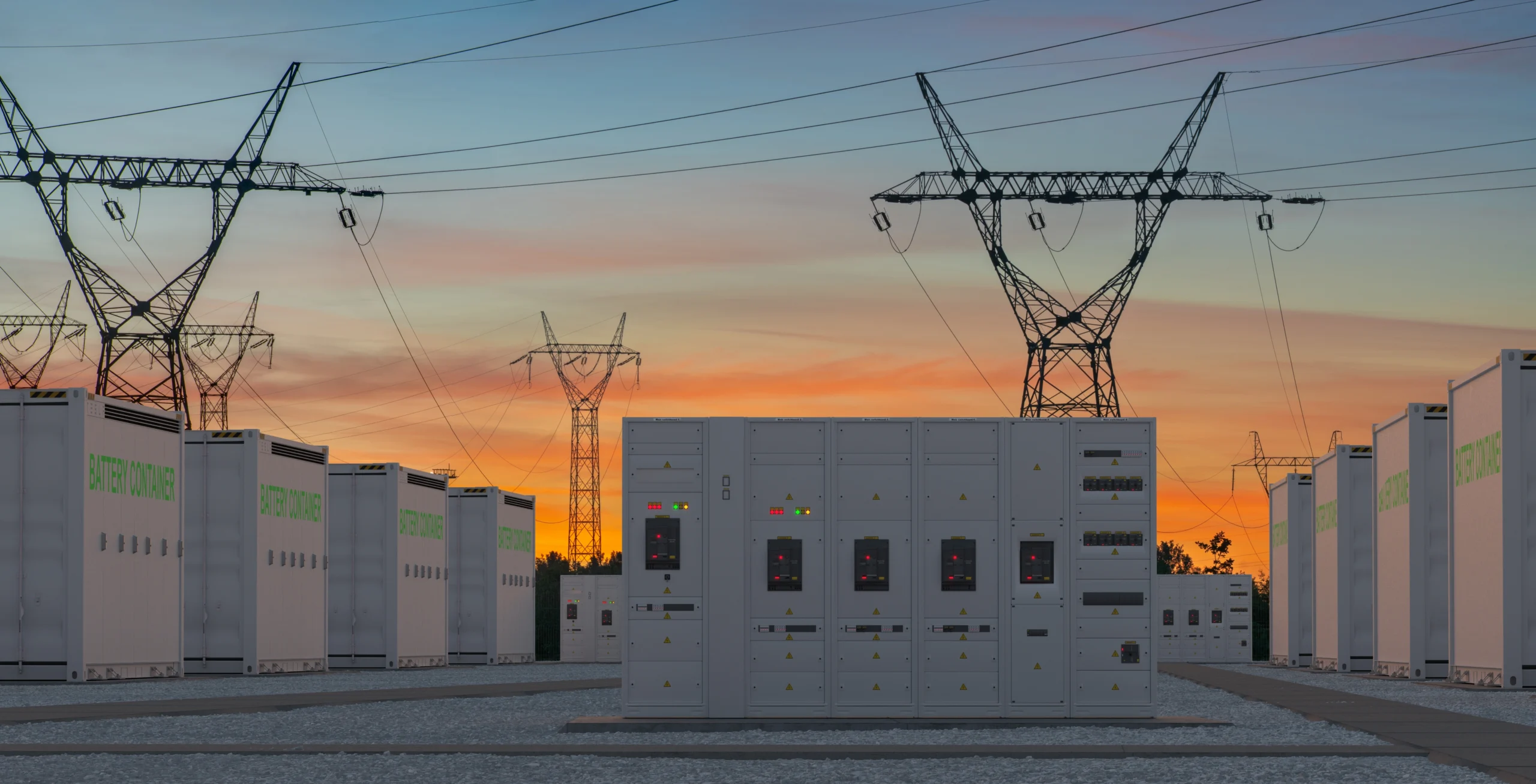
Leverage Expert insights and Data to understand where the energy storage market is headed and position your organization to capitalize on it.
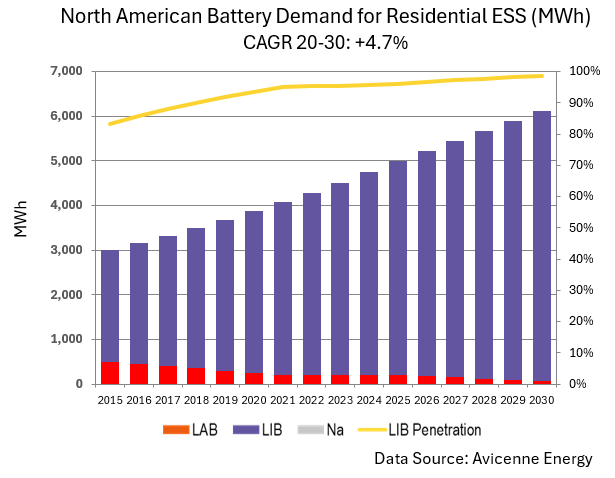
North American Battery Demand for Residential ESS Will Reach over 6 GWh by 2030
In 2025, North America had a 29% Share of Lithium-Ion Battery Demand for Grid-Scale ESS
North American Battery Demand for the Grid-Scale ESS Will Reach over 200 GWh in 2030
Current volumes at existing U.S. battery cell facilities, coupled with offtake contracts approaching or surpassing capacity, are poised to catalyze the next wave of expansions. The growth in energy storage systems (ESS) further amplifies this demand trajectory.
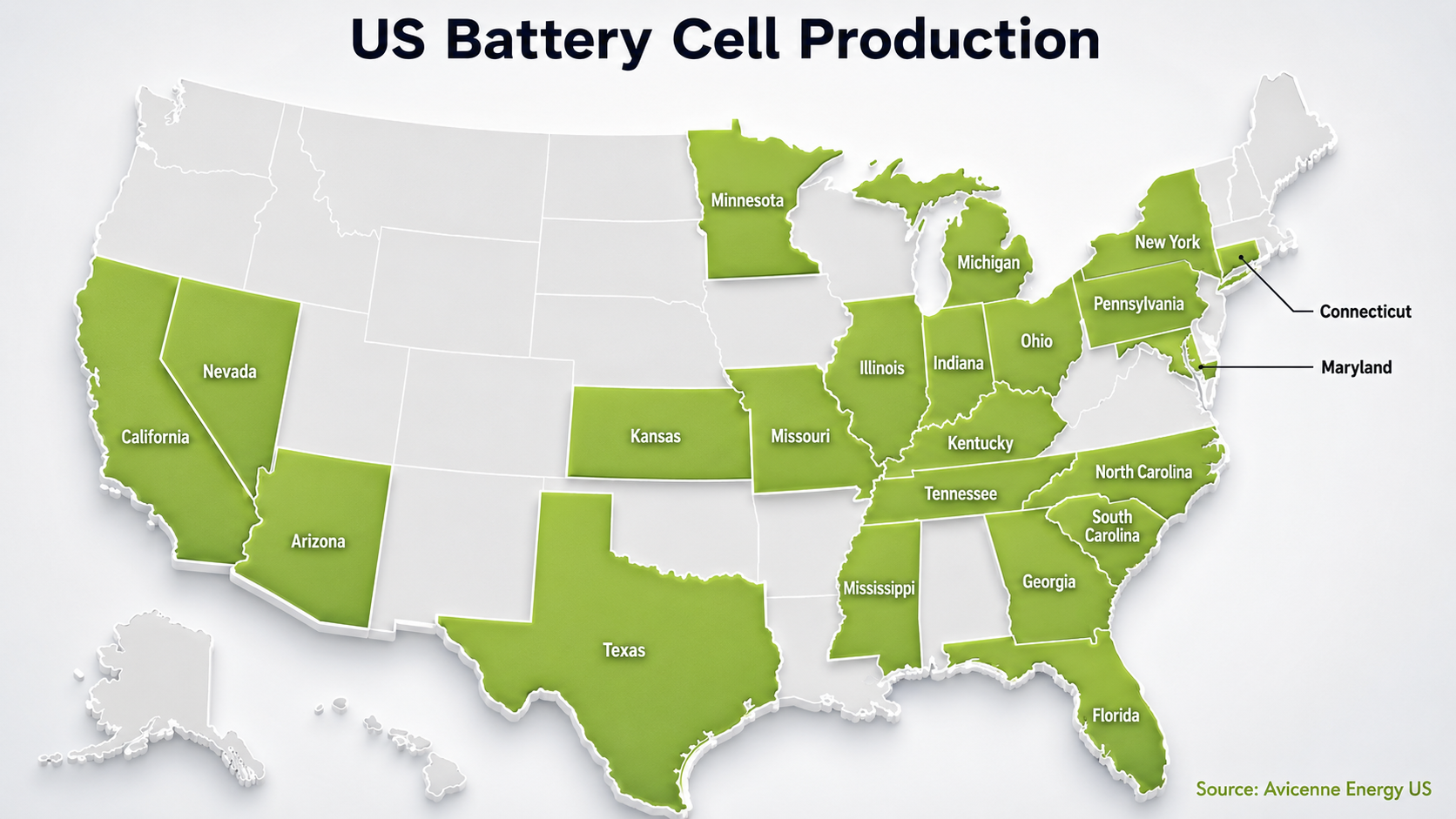
The U.S. accounted for 95% of North America’s 215 GWh of lithium-ion cell production in 2025. There are 11 gigafactories (cell plants with > 1 GWh of annual production) in the U.S. and 3 with 40+ GWh annual production.
Most of the largest plants have historically been driven by EV demand. This typically involves an automotive OEM partnering with a leading battery cell manufacturer, such as LG Energy Solution, Samsung SDI, or SK On, to establish a world-class battery cell production facility.
In a sign of ESS demand coming to the forefront and securing a greater share of production offtake, several U.S. battery plants have shifted production from EV batteries to ESS batteries. GM and LG Energy Solution are retooling part of their Ultium Cells Spring Hill facility from EV-focused production toward LFP cells for stationary ESS, driven by growth in grid storage and AI data center power demand. Ford has launched an energy storage subsidiary and plans to begin production in 2027.
Residential energy storage systems (ESS) are compact battery installations designed for individual homes, often integrated with rooftop solar panels. Typically measured in kilowatt-hours (kWh), these systems commonly offer 10–30 kWh of usable capacity.
In the U.S., their primary applications include providing backup power during outages, enabling self-consumption of solar energy, and participating in utility-driven virtual power plant (VPP) programs.
The battery chemistry in this segment is diverse, with lithium iron phosphate (LFP) gaining prominence over the older nickel manganese cobalt (NMC) chemistry due to lower costs, energy density not being a major consideration, and a superior safety profile.
The North American battery demand for residential ESS was 5 GWh in 2025 and is expected to exceed 6 GWh by 2030. Avicenne Energy forecasts its growth at a 4.7% CAGR. Lithium-ion penetration remains high, accounting for more than 95% of new installs by 2030. While residential ESS experiences steady growth, grid-scale ESS is where a majority of new opportunities lie.
Grid-scale energy storage systems (ESS) encompass large-scale battery installations directly integrated with the electric grid. These systems are typically owned or contracted by utilities, independent power producers, or grid operators such as PJM or CAISO.
In the United States, grid-scale ESS capacities are commonly measured in megawatts (MW) to gigawatts (GW) and serve critical roles, including frequency regulation, transmission-level peak shaving, renewable energy firming (e.g., pairing with solar or wind farms), and black-start capability.
Lithium iron phosphate (LFP) batteries dominate this segment due to their superior thermal stability, extended cycle life, and cost efficiency per kWh.
Growing at a 38% CAGR, North American battery demand for grid-scale ESS will exceed 200 GWh by 2030. In 2025, it accounted for more than 114 GWh. Lithium-ion remains the primary battery chemistry, accounting for the majority of new installs.
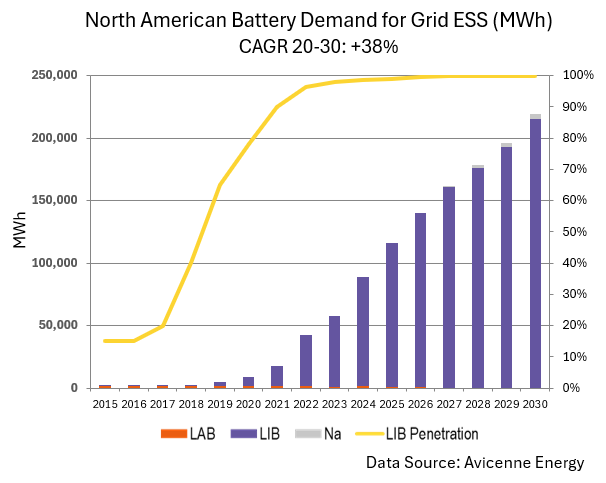
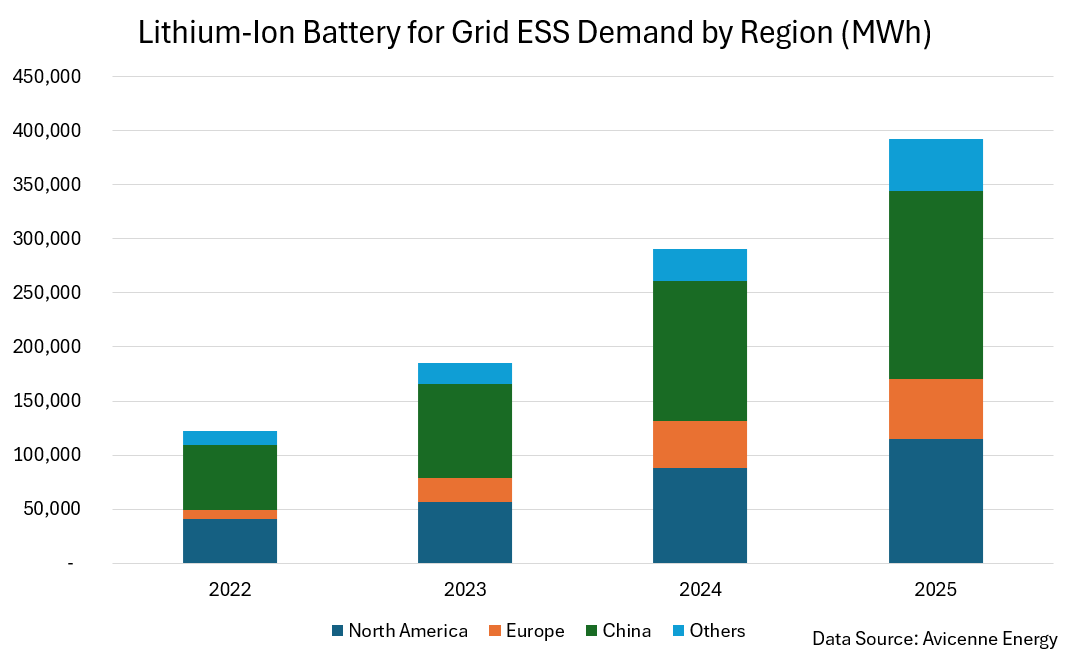
The grid-scale energy storage system (ESS) market in North America is greater than 20 times larger than the residential segment. A single utility-scale installation can store energy equivalent to tens of thousands of home batteries combined.
When considering the number of large-scale projects under development across the U.S. compared to residential installations, the grid-scale market overwhelmingly leads in total megawatt-hours deployed. For instance, a single large project in Texas or California can surpass the cumulative capacity of residential installations across an entire state.
As energy storage demand accelerates, driven by rapid growth in grid-scale ESS, evolving battery technologies, and shifting supply chain dynamics, Avicenne Energy provides the data, market intelligence, and expert guidance organizations need to make confident decisions and capture new opportunities.
Our seasoned experts bring extensive experience in electricity economics, grid-scale energy storage systems, and value creation across generation, distribution, and storage, giving clients a clear view of where the market is headed and how to position themselves for success.
Whether you’re looking to validate your approach, refine your strategy, or better understand where the ESS market is moving next, Avicenne Energy can help. Contact us today to start the conversation.